%20--%3e%3ccircle%20cx='32'%20cy='32'%20r='21.5'%20fill='none'%20stroke='%23F4F4F5'%20stroke-width='1.2'%20stroke-dasharray='2.8%204.2'%20stroke-linecap='round'%20opacity='0.42'/%3e%3cline%20x1='39.8'%20y1='27.5'%20x2='46.7'%20y2='23.5'%20stroke='%23F4F4F5'%20stroke-width='4'%20stroke-linecap='round'/%3e%3cline%20x1='39.8'%20y1='36.5'%20x2='47.1'%20y2='40.8'%20stroke='%23F4F4F5'%20stroke-width='4'%20stroke-linecap='round'/%3e%3cline%20x1='27.5'%20y1='39.8'%20x2='23.3'%20y2='47.2'%20stroke='%23F4F4F5'%20stroke-width='4'%20stroke-linecap='round'/%3e%3cline%20x1='24.2'%20y1='27.5'%20x2='16.4'%20y2='23'%20stroke='%23F4F4F5'%20stroke-width='4'%20stroke-linecap='round'/%3e%3ccircle%20cx='32'%20cy='32'%20r='9'%20fill='%23F4F4F5'/%3e%3ccircle%20cx='51'%20cy='21'%20r='5.2'%20fill='%23F4F4F5'/%3e%3ccircle%20cx='51'%20cy='43'%20r='4.6'%20fill='%23F4F4F5'/%3e%3ccircle%20cx='21'%20cy='51'%20r='4.6'%20fill='%23F4F4F5'/%3e%3ccircle%20cx='13'%20cy='21'%20r='4'%20fill='%23F4F4F5'/%3e%3c/svg%3e)
Community
Notes from delivery.
Articles, insights, and updates from the BalochDev team — like, comment, and share.
Most liked
Why We're Building — and Why We're Writing About It
BalochDev is a software studio building websites, web apps, AI features, and language technology from Balochistan. This is our first post — not a welcome message, but a position: why we started, what…

E-Commerce Is Not a Product Page
A serious online store requires more than just a product page, it needs robust operational systems. This article covers everything from checkout and inventory to fulfillment, loyalty, admin, and inte…

Is Your Website Invisible to AI? The 5-Minute Reachability Check
Run this 5-minute diagnostic to see if AI search engines can reach, read, and cite your site — and how to fix what's broken.

FAQ Sections That Double as Schema and AI Bait
The largest dataset on ChatGPT citations found FAQ schema doesn't move the needle the way GEO advice usually claims. Here's what actually drives citation in a Q&A section — and why it isn't the marku…

Does Page Speed Affect Whether AI Quotes You? Core Web Vitals and Citations
Slow pages don't just rank worse — they can be abandoned by AI crawlers before they're ever cited. Here's the two-part mechanism, the thresholds, and the highest-impact fixes.
![How to Get Mentioned in the Sources AI Already Trusts By BalochDev · Last updated September 4, 2026 AI engines systematically favor earned third-party sources over brand-owned content. As of April 2026, earned and news media account for 39.5% of all LLM citations, while owned and other content sits at 50.3% (Meltwater GenAI Lens, analysis of 5.35M citations) — but that split varies sharply by platform: ChatGPT gives 51.1% of its citations to earned media, while Claude allocates 53% to owned content. A perfectly structured page from an unknown domain still loses to a moderately structured page from a source the AI already trusts. The off-site authority layer is the one lever that schema, structured data, and answer-first writing can't substitute for — it has to be earned through presence on the sources AI already relies on. Why off-site authority is non-substitutable The retrieval layer of AI search scores passage quality. The re-ranking layer scores passage quality and source authority. That's why the earned-vs-owned split matters so much: ChatGPT and Claude have materially different source preferences, which means a balanced off-site strategy has to target both earned coverage and high-quality owned content — not lean entirely on one. Research tracking citation patterns across a large set of publications found that earned media in outlets like TechCrunch, Forbes, and Reuters generates citation rates that owned content — regardless of structural quality — simply cannot match (AuthorityTech's Publication Intelligence Index, 1,009 publications across 9 verticals). Structure determines how much value each earned placement extracts, but structure alone doesn't create the placement. The six off-site surfaces that move AI citation rates 1. Major news and trade publications. The highest-impact surface. A single mention in Reuters, TechCrunch, or a leading industry publication carries more citation weight than dozens of blog mentions. Target through digital PR: newsworthy data releases (your original research), expert commentary on breaking industry news, and product announcements with genuine news value. 2. Reddit. Reddit is cited roughly 3x more than Wikipedia across AI models (Profound data, via Bowen Craggs). Authentic participation in relevant subreddits — answering questions with genuine expertise, sharing original findings — builds citation presence that paid placement can't replicate. Don't promote; contribute. 3. Wikipedia and Wikidata. Wikipedia remains one of the most heavily weighted sources across most AI models, even though its raw citation share is small — it ranks in the top five cited sources for ChatGPT, Claude, Gemini, and Perplexity. Wikipedia requires notability; Wikidata doesn't. Build a complete Wikidata entry for your organization as a foundation, then earn Wikipedia notability through third-party coverage. 4. Industry directories and comparison platforms. G2, Clutch, Capterra, and vertical-specific directories are heavily indexed by AI engines for commercial queries. A complete, accurate, well-reviewed profile on the directories relevant to your category earns citations specifically on buyer-intent queries — the highest-value queries for a services business. 5. Podcast appearances and transcripts. AI engines increasingly index podcast transcripts and video content generally — YouTube in particular ranks among the top five cited sources for six of eight major AI platforms. An appearance where you provide a quotable, specific insight creates a citable passage attributed to you on a third-party domain. Prioritize podcasts with published transcripts or show notes. 6. Expert quotes in others' articles. HARO (now Connectively), Qwoted, and journalist sourcing platforms connect you to writers who need expert quotes. A named quote in a well-trafficked article is both a citation opportunity and an entity signal — AI sees your name connected to your expertise in a trusted context. Entity co-occurrence: the quality multiplier Off-site mentions earn more citation weight when they include high-salience entity descriptions. AI systems weight mentions that pair your brand name with a clear description of what you do far more heavily than a bare hyperlink or brand-name drop. When providing a quote or comment to a journalist, include your entity description: "According to [Your Name], [Title] at [Company], [a brief description of what the company does]..." The journalist will often include it verbatim, creating a high-salience mention that connects your brand clearly to your category. Diversify across source types — no single platform is a safe bet AI visibility is fragmented by design: ChatGPT behaves like an institutional-authority engine leaning on earned media and Wikipedia; Claude leans more heavily on structured, owned data; Grok is almost entirely social-first; Perplexity and Google's AI surfaces draw heavily on YouTube. A brand can be highly visible on one platform and nearly invisible on another, and the mix shifts month to month — Reddit's and social citation shares, for instance, have moved by several percentage points in a single month on some platforms. The practical implication: don't build off-site presence on one surface and assume it covers you everywhere. A brand with earned media coverage but no Wikidata entry, no directory presence, and no video content is well-positioned on ChatGPT but weak on Perplexity and Google's AI surfaces. Building presence across several independent, non-affiliated surface types — press, community platforms, directories, video, and structured entity records — is what holds up as the underlying mix keeps shifting. Frequently asked questions Is digital PR for AI citations different from traditional digital PR? The targets overlap significantly — major publications matter in both. The difference is the metric: traditional digital PR tracked backlinks and referral traffic; AI-era digital PR tracks brand mention rate across sources AI trusts and citation frequency in AI answers. Measure both. Do social media mentions count? Increasingly, yes — but unevenly across platforms. Social citations grew from 5.6% to 7.2% of all AI citations in a single month in Meltwater's tracking, and LinkedIn specifically saw sharp month-over-month growth on several models. But the weight varies enormously by platform: Grok is heavily social-first, while Claude leans toward structured, owned content over social mentions. How long until off-site mentions affect AI citations? Citation authority from new third-party mentions generally compounds over a period of months rather than weeks. It's the slowest lever and the most durable one — start early, and measure monthly rather than quarterly, since the underlying source mix can shift meaningfully within a single month. Sources & further reading Nathaniel Pallen, AI Search Visibility Report: Earned Media, YouTube, and LinkedIn Are Reshaping AI Visibility — Meltwater, May 28, 2026 (GenAI Lens analysis of 5.35M citations) What to know about Reddit and Wikipedia in the AI search age — Bowen Craggs, citing Profound data How Content Structure Affects AI Citation Rates: The GEO-SFE Research Framework — Machine Relations, citing AuthorityTech's Publication Intelligence Index (1,009 publications, 9 verticals)](https://res.cloudinary.com/durazkwc0/image/upload/v1788594676/balochdev/blog/wm7kdx7kyovdk24j3gyo.png)
How to Get Mentioned in the Sources AI Already Trusts
ChatGPT trusts earned media; Claude trusts owned content. Here's the six off-site surfaces that actually move AI citation rates — and why no single one is a safe bet.

Why Original Data Is the Only Content AI Can't Copy From You
Original research earns 3x more AI citations than other content — but a real citation-data audit found the effect is concentrated almost entirely in one format. Here's what actually works.

Entity SEO: Teaching AI Who Your Brand Is
Backlinks barely move the needle for AI citation — brand mentions do, at three times the strength. Here's the five-signal framework for becoming a recognized entity AI systems trust enough to cite.

Topical Authority: How to Own a Subject in the Eyes of an LLM
A domain with 15 focused, interlinked articles beats one with 100 scattered across five topics. Here's how to build the pillar-cluster structure that earns AI engines' trust.

The Answer-First Formula: Writing Openings AI Will Quote
Most content already has the right answer — it's just buried in paragraph four. Here's the exact formula for openings that AI systems quote instead of skip.

Structured Data for E-Commerce: Getting Products Into AI Answers
Your feed decides if you're eligible; your product page still supplies most of what gets cited. Here's the exact schema and feed setup AI shopping needs.

Organization, Article, FAQPage: The Schema Every Business Needs
Three schema types, three reasons AI passes you over: unverified publisher, unclear recency, and no extractable answer. Here's why each one matters.
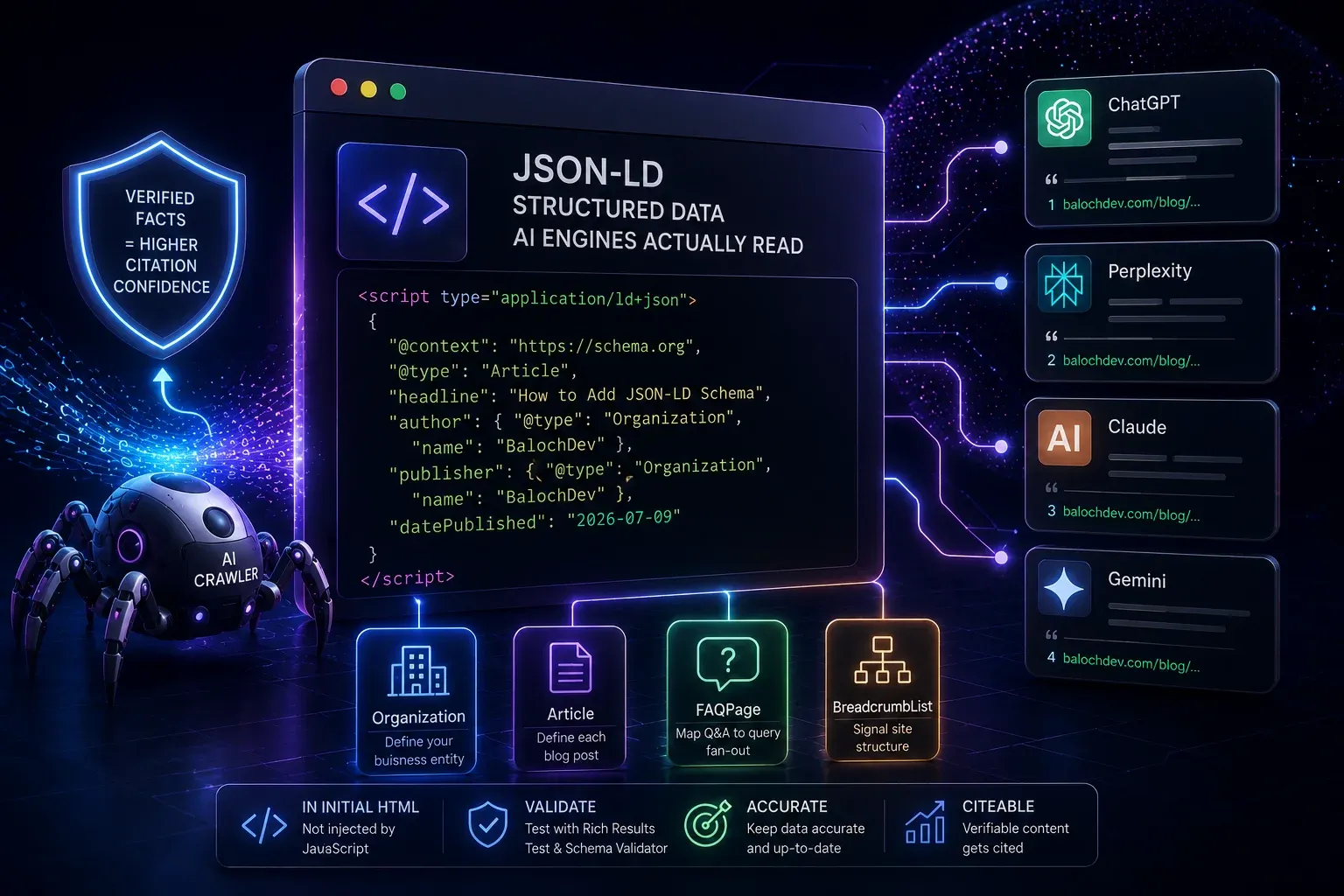
How to Add JSON-LD Schema That AI Engines Actually Read
The exact JSON-LD code for Organization, Article, FAQPage, and BreadcrumbList schema — and the 4 mistakes that make it invisible to AI crawlers.

Client-Side Rendering Is Killing Your AI Visibility — Here's the Fix
Excerpt (card): AI crawlers don't execute JavaScript — a React or Vue site can look flawless in a browser and be completely blank to ChatGPT. Here's the 30-second test.

Is Cloudflare Blocking AI Bots From Your Site? How to Check and Fix It (2026)
Your robots.txt looks fine and Search Console shows no errors — but Cloudflare can still block AI crawlers at the edge before they reach your page.

robots.txt for AI Crawlers: Which Bots to Allow and Which to Block (2026)
GPTBot, ClaudeBot, PerplexityBot — allow or block? The exact robots.txt config that keeps you eligible for AI citations without losing training control.

Will AI Search Kill SEO? An Honest 2026 Assessment
Gartner predicted a 25% drop in search volume. It didn't happen — but publisher traffic fell 38% anyway. Here's the honest, data-backed verdict.

Share of AI Voice: The Metric That Replaces Google Rankings
A #1 Google ranking can mean zero AI visibility. Here's Share of AI Voice — the metric that actually measures whether AI names your brand.
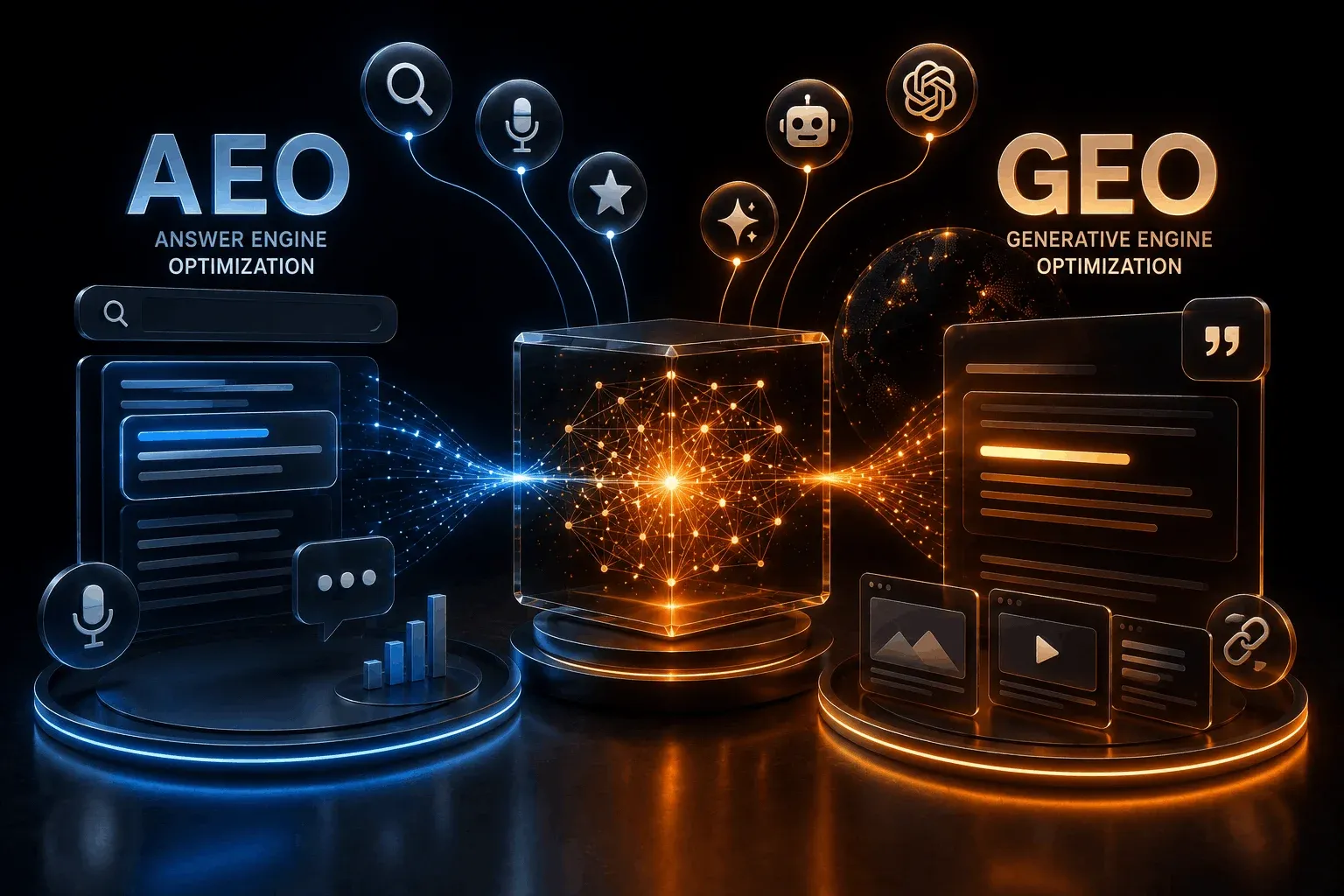
AEO vs GEO: Do the Differences Actually Matter?
AEO and GEO overlap so much the tactics are nearly identical. Here's the precise difference between them — and which term actually matters more.

How AI Search Engines Actually Pick Their Sources (Passage-Level Retrieval, Explained)
AI search doesn't rank your page — it retrieves passages. Here's the exact RAG pipeline, from chunking to citation, that decides what gets quoted.

What Is a Google AI Overview, and How Does It Choose What Goes In?
Google AI Overviews don't rank pages — they fan a query into sub-questions and quote the best passage for each. Here's exactly how the selection works.
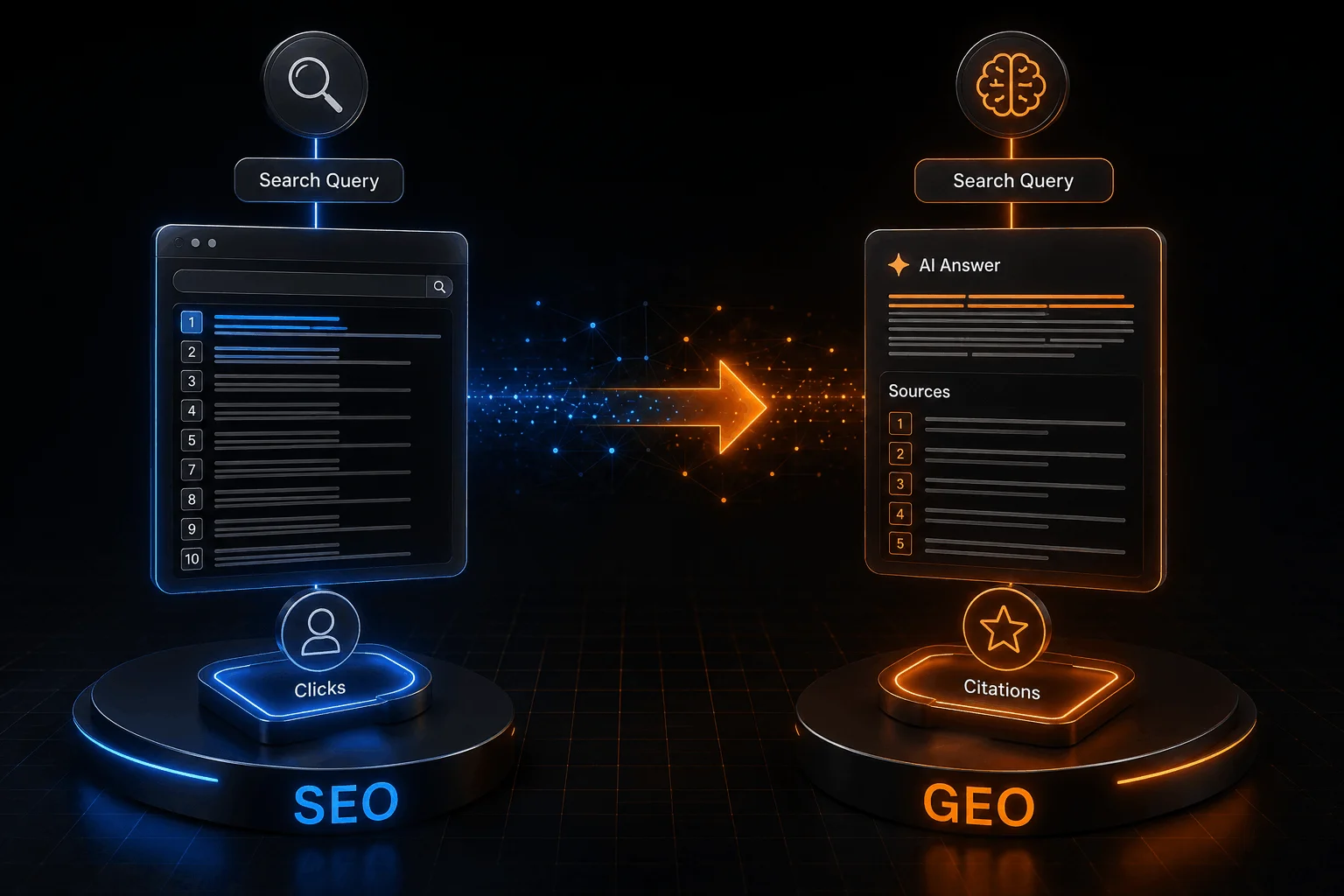
GEO vs SEO: What Actually Changed When Search Became an Answer
SEO ranks pages in a list; GEO gets you cited inside a single AI answer. Here's exactly what changed, what didn't, and how to win both.

The Zero-Click Web: What Businesses Lose When Nobody Clicks Through
68% of Google searches now end without a click. Here's exactly what businesses lose when that happens — and what actually replaces the click.

How to Get Cited by ChatGPT Search: A Practical Guide (2026)
ChatGPT cites through two separate paths — training data and live retrieval. Here's exactly how OAI-SearchBot picks sources, and how to be one of them.

Why Ranking #1 on Google No Longer Gets You Cited by ChatGPT
Ranking #1 and getting cited by ChatGPT are different games now. Here's why the overlap has collapsed — and what actually earns the citation.

System Architecture Design: A Practical Guide from Monolith to Distributed Systems
Most teams treat architecture as a technology choice. It's actually a business decision — one that determines how fast a team can ship, hire, and recover from failure. Here's a practical map from mon…
Balochi Has Survived Mountains, Deserts, and Borders. Now Comes the Algorithm
Suroz AI, an AI music generator, is currently under development by Baloch Dev. It will generate Balochi music as well as music in all other available languages.
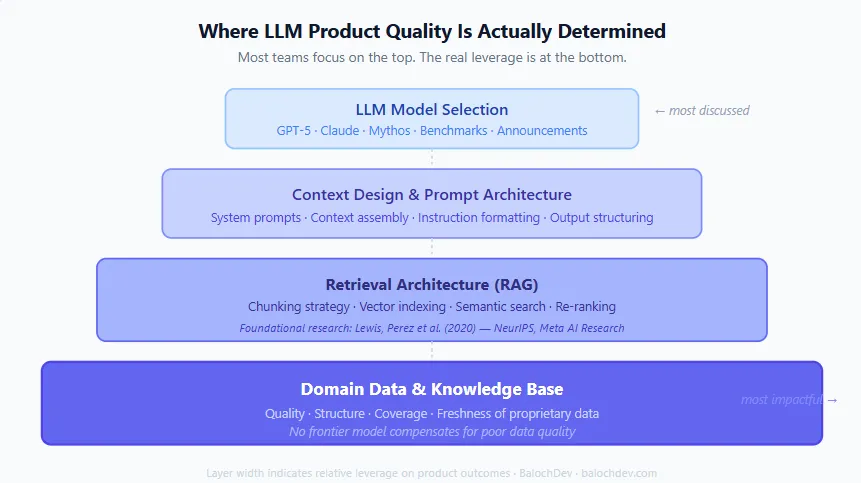
The AI Model Race Won’t Build Your Product: What Actually Matters for LLM Integration in 2026
GPT-5. Apple Intelligence. Anthropic Mythos. A new frontier model launches every few weeks. Here’s what that race means if you’re the one actually shipping.