Blog
Topical Authority: How to Own a Subject in the Eyes of an LLM
Topical authority is the degree to which an AI engine recognizes your domain as a reliable, comprehensive source on a specific subject — not just a single page, but a network of interlinked, consistently structured content that collectively covers the topic with depth. AI engines build a topic model of your site over multiple crawls: which subjects you cover, how consistently, how deeply, and how often you're cited on those subjects. A site with 15 well-structured, interlinked articles on GEO is more topically authoritative on GEO than a site with 100 articles spread across GEO, SEO, social media, email marketing, and productivity — because signal clarity beats coverage breadth.
Why topical authority matters for AI citation
Traditional SEO built topical authority through keyword clustering and internal linking. The goal was to signal to Google that a site covered a subject comprehensively, earning broader ranking across the topic. The AI-era logic is similar but operates differently.
AI engines don't just retrieve individual passages — they develop a model of which sources are reliable for which subjects across many retrieval cycles. Academic research on citation behavior across AI answer engines has found that question-based heading structure and consistent semantic HTML are among the page-quality signals most strongly associated with citation (GEO-16 framework, arXiv 2509.10762). When many pages on the same domain share this structure and cover a coherent subject area, the domain earns a subject-level trust signal — not just page-level passage quality.
The pillar-cluster model for AI
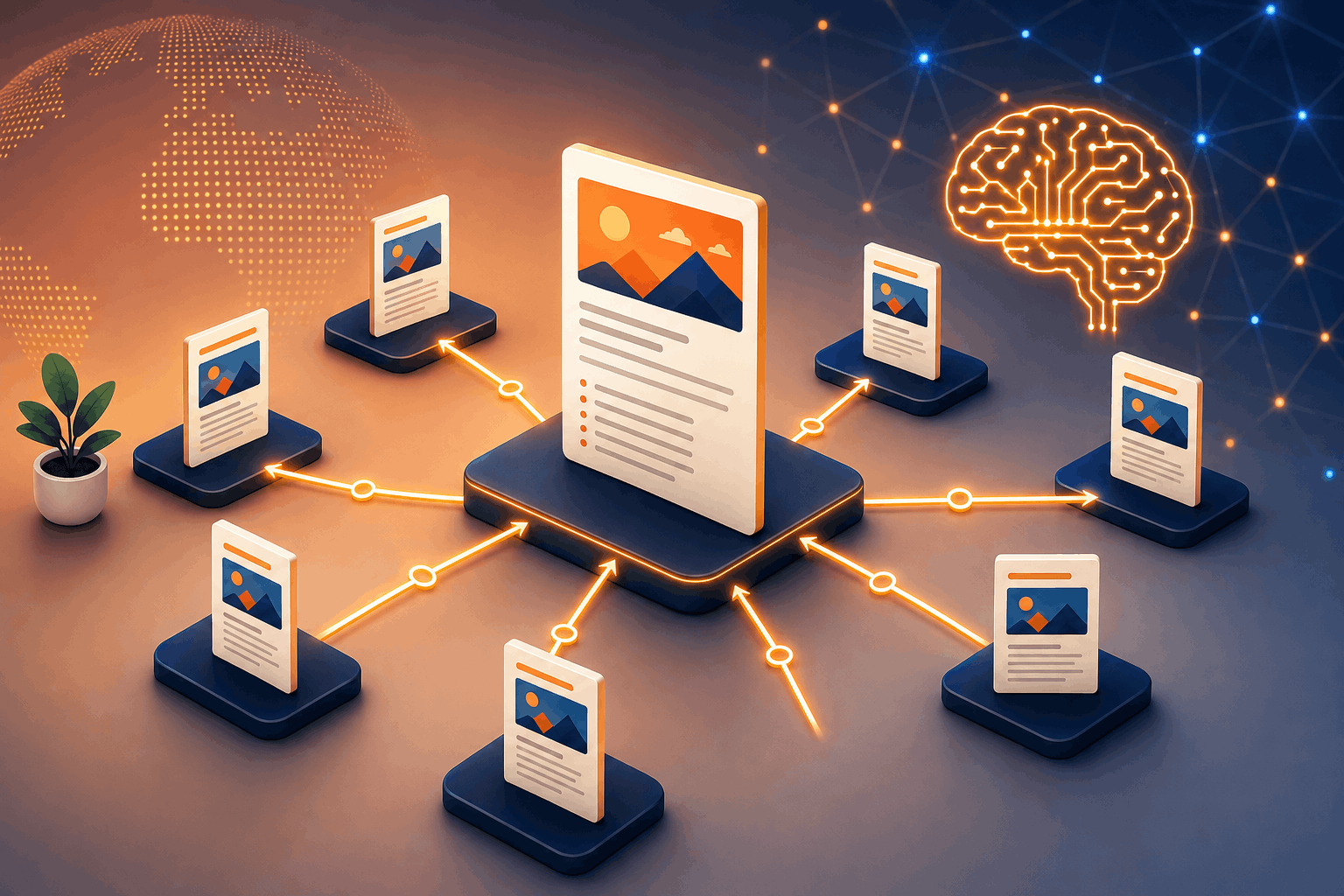
The most effective topical authority structure for AI citation is the pillar-cluster model: one comprehensive pillar article covering the subject broadly, with a cluster of supporting articles each addressing a specific sub-topic in depth. Every cluster article links to the pillar; the pillar links to every cluster article.
This structure matters for AI for three reasons:
It creates multiple entry points for AI sub-queries to retrieve relevant passages
The internal linking signals topic coherence across the domain
The pillar provides the broad overview passage AI needs for summary-type queries, while cluster articles provide the deep passage AI needs for specific sub-questions
The BalochDev GEO cluster is itself built on this model: the pillar (How to Get Your Business Found by AI Search in 2026) links to every supporting article, which each cover a specific sub-topic in depth and link back to the pillar.
How to build topical authority systematically
Step 1 — Define the subject boundary. Topical authority is strongest when it's narrow. "AI search visibility for B2B businesses" is a defensible subject. "Digital marketing" is too broad to dominate. Pick the specific territory you can cover better than anyone.
Step 2 — Map the sub-topics. List every question a buyer in your subject area would ask. Group questions into clusters. Each cluster becomes a supporting article; the entire map becomes the pillar.
Step 3 — Cover each sub-topic with one dedicated page. Don't answer multiple sub-topics on one page — each page should be the authoritative source for one specific question. Cross-link related pages rather than cramming multiple topics onto one page.
Step 4 — Use consistent structure. Every article in the cluster should follow the same template: answer-first lead, consistent heading hierarchy, FAQ section with schema, internal links. Structural consistency across a cluster is a topical authority signal — it tells the AI this content comes from a systematic source, not random one-offs.
Step 5 — Publish and interlink before expanding. A tight, interlinked cluster of 10 articles earns more topical authority than 50 loosely related articles with no internal link structure. Build depth before breadth.
The narrower the topic, the faster you win
Query fan-out is the technique Google's AI Mode and AI Overviews use to expand one user question into multiple related sub-queries, retrieve evidence for each in parallel, and synthesize a final answer from the combined results (Google Search Central). You optimize for it by building a hub of pillar and supporting pages that together cover the full cluster of sub-queries a topic generates.
In a narrow topic, a well-built cluster can achieve citation dominance within months — there's less competition at the passage level. In a broad topic (general SEO, general marketing), you're competing with sites that have years of head start. Choose the narrow lane where your engineering expertise gives you an unfair advantage — and build the definitive cluster on that lane.
Frequently asked questions
How many articles does it take to establish topical authority? There's no fixed number, but industry data generally points to somewhere in the 10–15 tightly interlinked article range for a specific subject to produce measurable topical authority signals. Quality and coherence matter more than count.
Does topical authority transfer between subjects? Partially. A domain with strong topical authority in software development gets a trust boost on adjacent subjects (AI tools, developer productivity) but not on unrelated subjects (cooking, travel). Build topical authority in your core domain first, then expand into adjacent areas.
Can a new domain build topical authority quickly? Yes — more easily than it can build backlink authority. A new domain with a systematic, well-structured cluster on a specific narrow topic can typically earn AI citation faster on Perplexity, which indexes and cites fresh content in real time, than on ChatGPT or Google AI Overviews, which lean more heavily on authority signals that build over a longer period. Topical authority is a faster path to AI citation than link building for new sites.
Sources & further reading
Google Search Central, "AI Features and Your Website" — official documentation on query fan-out and AI Overviews/AI Mode
"AI Answer Engine Citation Behavior: Bringing the GEO-16 Framework in B2B SaaS" — arXiv 2509.10762, empirical study linking heading structure and semantic HTML to citation outcomes