AI · Blog
Why Ranking #1 on Google No Longer Gets You Cited by ChatGPT
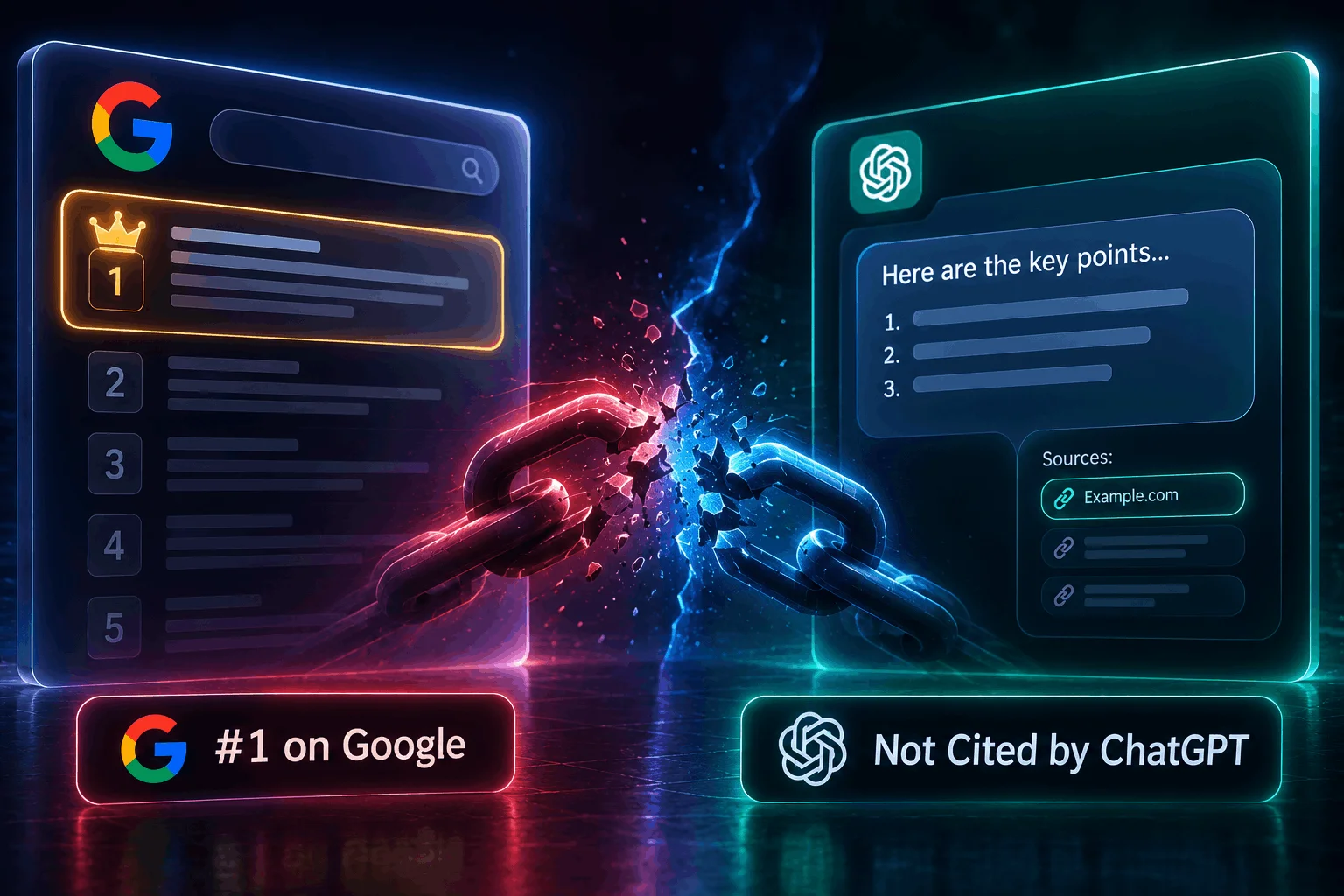
Ranking #1 on Google and being cited by ChatGPT are two different achievements produced by two different systems. Google ranks whole pages by position; AI answer engines score individual passages for how well they answer a specific question, then quote a handful. Because the criteria differ, a page can dominate Google's results and still never appear in an AI answer. Multiple independent 2026 studies confirm the split is real and widening: Ahrefs' analysis of 15,000 long-tail queries found that only 12% of URLs cited by AI assistants also rank in Google's top 10, and 5WPR's GEO Practice Guide reports the overlap between top Google rankings and AI-cited sources has collapsed from roughly 70% to under 20%.
This surprises a lot of businesses that spent years earning the top spot. So let's take it apart: why the two diverged, the exact ways a #1 page still fails, and what earns the citation instead.
Two systems, two questions
Traditional ranking asks: which page best deserves this position for this keyword? It weighs backlinks, authority, relevance, and technical health, and produces an ordered list.
AI retrieval asks a narrower question: which specific passage most cleanly answers the exact thing the user asked — and can I trust and quote it? As Ahrefs' guide to retrieval-augmented generation explains, the model converts the query and each content chunk into embeddings, then measures how semantically close they are before selecting which passages to use. It breaks pages into chunks, matches them semantically to the query, checks whether each chunk actually answers the sub-question, and assembles a response from the best few.
Same web, different question. The list-ranking system optimizes for the best page overall. The answer system optimizes for the best sentence for this moment. Those don't produce the same winners.
The evidence: the overlap collapsed
If ranking and citation measured the same thing, the sources AI cites would mostly be the pages Google ranks first. They increasingly aren't. Ahrefs' data scientist ran 15,000 long-tail queries through Google, Bing, and four AI assistants (ChatGPT, Gemini, Copilot, and Perplexity) and found that on average just 12% of AI citations also rank in the top 10 — meaning roughly 80% of what AI cites doesn't rank anywhere for the same query in traditional search. Separately, 5WPR's May 2026 research puts the historical baseline at around 70% overlap, now fallen to under 20%. Different methodologies, same conclusion: a big share of AI citations go to pages that aren't in Google's top results, and many top-ranked pages are never cited.
That's the whole thesis in one data point. Now the mechanism behind it.
The four ways a #1 page still fails to get cited
1. The crawler can't read it. If your page is rendered in the browser with JavaScript, an AI crawler that doesn't execute JS receives an empty shell — while Google, which renders more patiently, still ranks the hydrated version. Result: #1 on Google, invisible to AI. This is the most common and most invisible failure.
2. The answer is buried. Ranking tolerates a long, keyword-rich intro before the payoff. AI retrieval doesn't — it favors passages that state the answer up front, cleanly. A page that makes the reader (or the model) dig for the answer loses the extraction contest even if it ranks well.
3. The passage isn't verifiable. AI prefers claims it can trust: specific numbers, named sources, structured data. A #1 page full of confident but unsourced, unstructured assertions is hard to quote with confidence, so the engine reaches for a lesser-ranked page that is quotable.
4. The web's consensus is thin. Ranking leans on backlinks; AI leans more on how consistently you're described across sources it already trusts. A page can win the backlink game and still lack the clear, repeated entity signals that make an AI confident about who you are and what you do.
Any one of these can sink a top-ranked page. Most under-cited sites hit two or three at once.
What earns the citation instead
The inverse of those four failures:
Be readable — server-render or statically generate your content so the full text is in the HTML before any script runs.
Lead with the answer — put the direct response in the first 40–60 words of the page and each section.
Be verifiable — back claims with specific figures, dates, and named sources, and add structured data (JSON-LD schema) so machines can confirm what the page is.
Be consistent — name your business and category explicitly and repeatedly, and earn mentions on the directories and publications AI already trusts.
None of this requires abandoning your Google ranking. A well-structured, answer-first, verifiable page tends to rank and get cited — you're adding a layer, not switching sides. For the full sequence, see our pillar guide, How to Get Your Business Found by AI Search in 2026, and for the broader distinction, GEO vs SEO: What Actually Changed.
The upside for challengers
Here's the part that should encourage anyone who isn't already #1: because citation runs on structure and clarity more than on decades of accumulated backlinks, you can earn AI citations without first winning a ranking war you might never win. The playing field for the answer box is younger and flatter than the playing field for the blue links. A newer, well-built site can be cited alongside — or instead of — incumbents who are still optimizing only for a results page fewer people click.
Frequently asked questions
If I rank #1, why would AI ignore my page? Because AI runs a separate retrieval system that scores passages, not page rank. If your content is hard to fetch, hard to extract a clean answer from, or hard to verify, the engine picks a more quotable source — regardless of your Google position.
Does improving GEO hurt my Google ranking? No. The changes that help AI cite you — readability, structure, verifiable claims, clear entities — also support strong SEO. They reinforce each other.
How do I find out if AI is citing me? Ask ChatGPT (with search on) and Perplexity a question a customer would ask about your category, and see whether you're named and described accurately. Our 5-minute reachability check walks through this and four other quick tests.
Should I stop doing SEO? No. AI engines read the live web, so your SEO foundation feeds your AI visibility. Keep the foundation; add the GEO layer on top.
This guide is maintained by BalochDev, an AI-first software development studio. We build products — and the sites that sell them — to be found by both people and machines. Last updated 9 July 2026.
Ranking well but not showing up in AI answers? Our AI Visibility Audit pinpoints exactly which of these failures is keeping you out — and how to fix each one. Get in touch.
Sources & further reading
Ahrefs — "Only 12% of AI Cited URLs Rank in Google's Top 10 for the Original Prompt" (2026) — https://ahrefs.com/blog/ai-search-overlap/
5WPR — "New 5W Research: Overlap Between Top Google Rankings and AI-Cited Sources Has Collapsed From 70% to Under 20%" (May 2026) — https://www.prnewswire.com/news-releases/new-5w-research-overlap-between-top-google-rankings-and-ai-cited-sources-has-collapsed-from-70-to-under-20-302760132.html
Ahrefs — "Retrieval-Augmented Generation (RAG) Explained: How AI Decides Which Pages to Search & Cite" — https://ahrefs.com/blog/retrieval-augmented-generation/