Blog
GEO vs SEO: What Actually Changed When Search Became an Answer
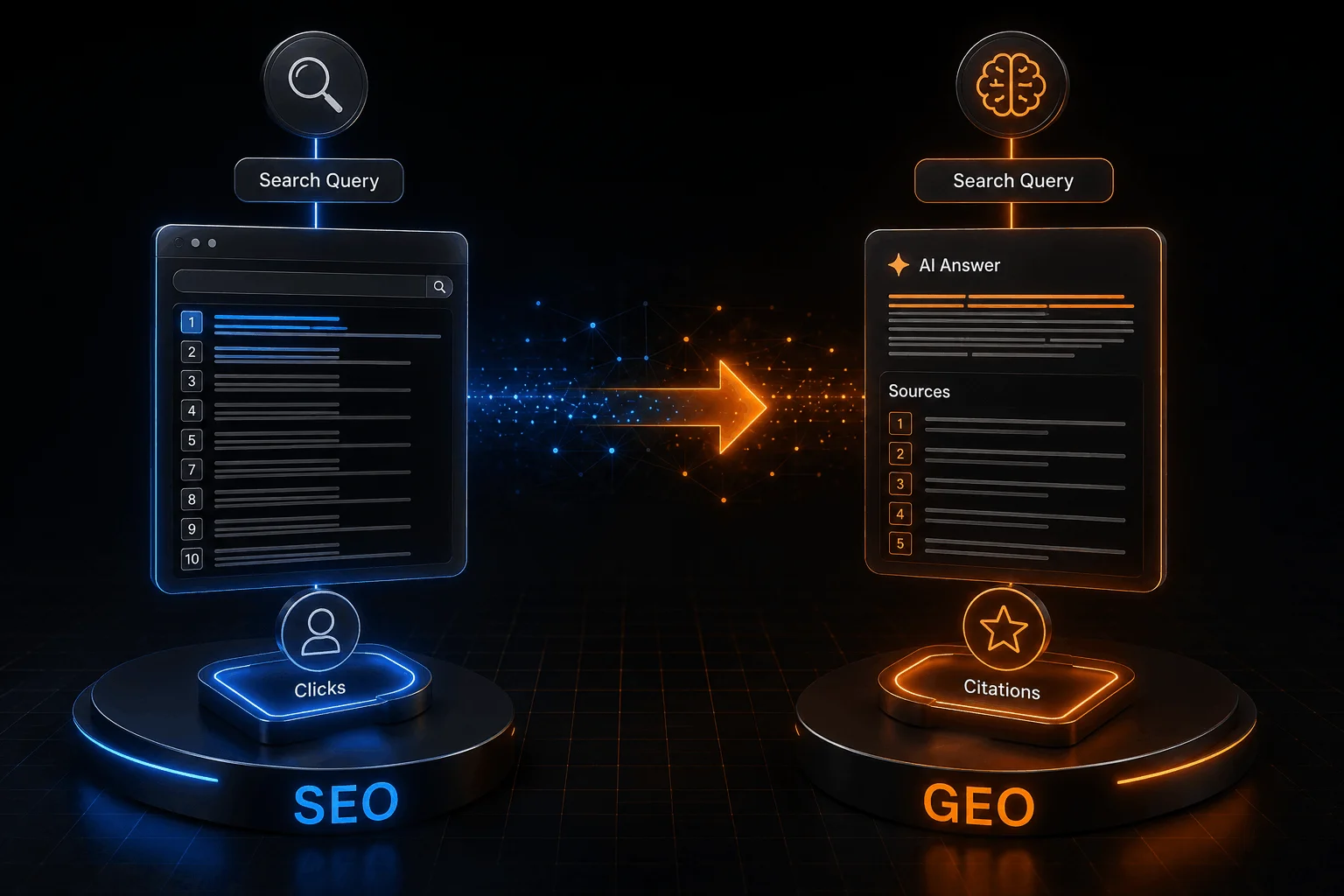
SEO optimizes to rank in a list of links. GEO optimizes to be cited inside a single AI-generated answer. That's the whole difference — and it exists because search itself changed shape. When a search engine returns ten blue links, the game is position. When an AI returns one synthesized answer that names two to seven sources, the game is citation. GEO (Generative Engine Optimization) is SEO's new layer, built on the same foundation but aimed at a different finish line.
The confusion around these two terms comes from treating them as rivals. They're not. To use them well, you have to see exactly where they overlap and exactly where they diverge.
The one change that started everythin
For twenty years, a search returned a list. You optimized to climb that list, because higher position meant more clicks. The unit of value was your rank.
Now a large share of searches return an answer instead — Google's AI Overviews, ChatGPT search, Perplexity, Copilot. The AI reads multiple pages, extracts the relevant passages, writes one response, and cites a handful of sources. SparkToro's 2026 clickstream research found that 68% of U.S. Google searches now end without a click — a growing majority of searches end without any click to a website at all, because the answer is consumed on the page.
That single shift — from list to answer — cascades into every difference between SEO and GEO. Once you internalize it, the rest follows logically.
What stayed the same
GEO is not a teardown of SEO. These foundations carry straight over, and getting them wrong breaks both:
Crawlability. If an engine can't fetch and read your page, neither search nor AI can use it.
Content quality. Thin, inaccurate content loses in both worlds.
Site authority. A trusted domain is trusted by both ranking algorithms and AI retrieval.
Technical health. Speed, clean HTML, and a working sitemap help everywhere.
This is why "SEO is dead" is wrong. AI engines pull from the live web, so strong technical SEO feeds GEO directly. You don't abandon the foundation — you build a new floor on top of it.
What actually changed
Here's where the list → answer shift forces real divergence:
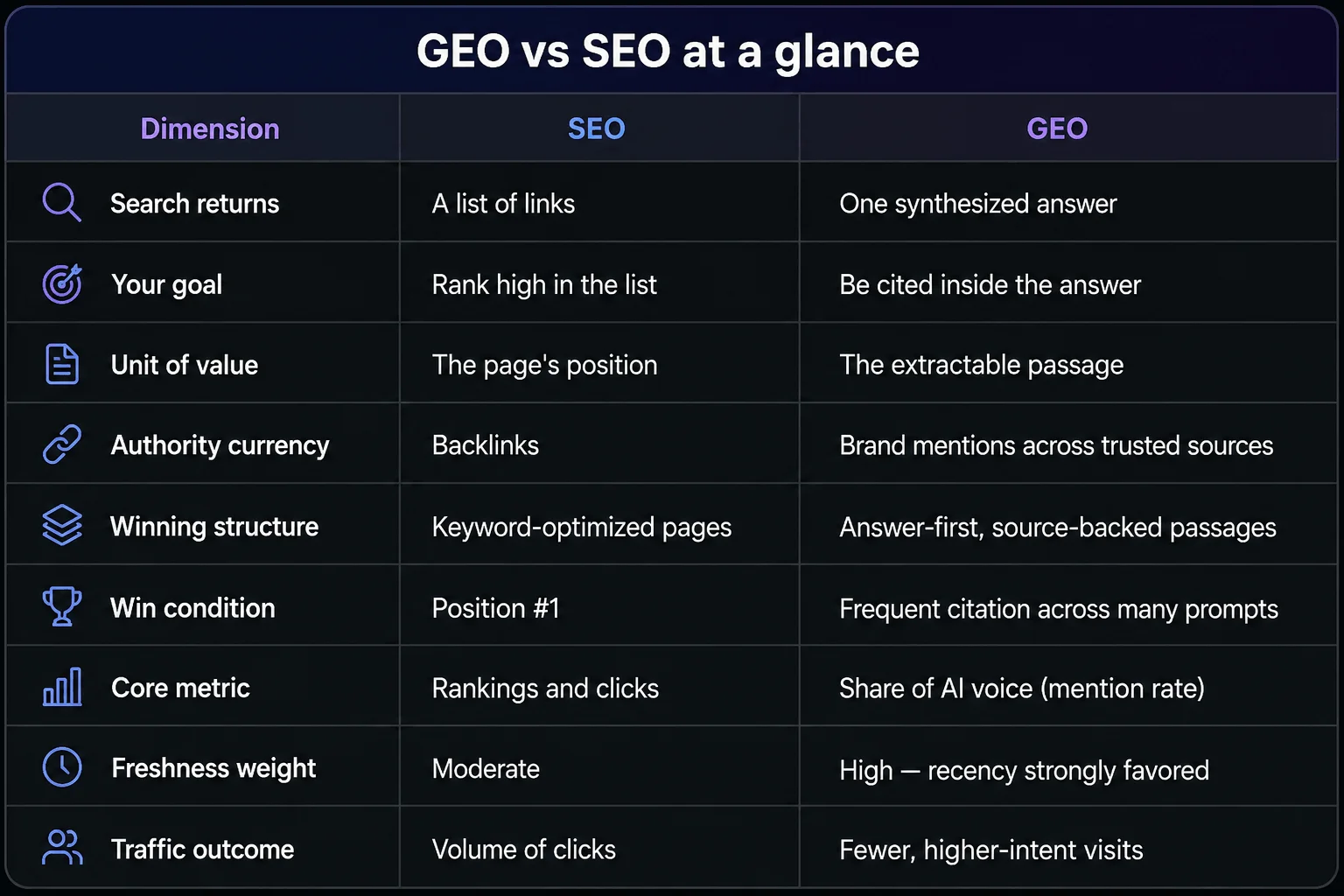
The unit of value moved from the page to the passage. SEO optimizes a whole page to rank. GEO optimizes individual passages to be extractable, because AI lifts specific sentences to answer specific sub-questions. A page can rank well and still be too unstructured for an AI to quote cleanly.
The currency of authority moved from links to mentions. In SEO, backlinks are the dominant trust signal. In GEO, what matters more is being mentioned and described across sources the AI already trusts — directories, reputable publications, comparison sites. AI is reading the web's consensus about you, not just counting who links to you.
The metric moved from rank to share of voice. There is no "position #1" inside an AI answer. There's only how often you're named across many different prompts on your topic. You stop tracking rankings and start tracking mention frequency — your share of AI voice.
The winning structure moved from keyword-rich to answer-first. SEO rewarded pages built around keywords. GEO rewards pages that state the answer up front, in clean, quotable, verifiable form — direct answers in the first 40–60 words, backed by statistics, dates, and named sources. The foundational GEO research paper from Princeton, Georgia Tech, the Allen Institute for AI, and IIT Delhi — presented at KDD 2024 and tested across 10,000 queries — found that adding citations, quotations, and statistics to a page boosted its visibility in generative engine answers by more than 40%, while keyword stuffing had little to no effect.
Notice the shared DNA: both need quality, crawlability, and authority. They only split at the finish line — rank versus citation.
The traffic trade-off nobody mentions
GEO usually sends less traffic than peak-era SEO — because many users get their answer without clicking. But the traffic it does send tends to convert at a notably higher rate. A visitor who arrives after an AI has already explained your category and named you as a credible option is closer to a decision than a cold searcher scanning ten links. You're trading volume for intent. For a services business, that's often the better trade.
So where should you put your effort?
You don't choose one. You sequence them:
Keep the SEO foundation. Crawlable, fast, authoritative, well-structured. It's the floor GEO stands on.
Add the GEO layer. Answer-first openings, structured data, quantified claims with sources, explicit entity naming, visible dates, and mentions on sources AI trusts.
Change what you measure. Add share of AI voice alongside rankings, and watch conversion quality, not just click volume.
If you're a newer business, there's an opportunity hidden here: GEO leans less on decades of backlinks and more on structure and clarity, which means you can earn citations faster than you could ever have out-ranked established competitors. The finish line moved, and it moved closer.
Frequently asked questions
Is GEO replacing SEO? No. GEO is a layer built on SEO. AI engines use live web data, so strong technical SEO directly improves your GEO results. You need both.
Can a page rank #1 on Google but not get cited by AI? Yes — routinely. Ranking and citation run on different systems. AI retrieval scores individual passages for how well they answer a specific question, which a top-ranking but poorly structured page can still fail.
Do I need separate content for SEO and GEO? Usually not. One well-structured, answer-first, source-backed page can rank and be citable. GEO mostly changes how you structure and write, not how many pages you produce.
What's the fastest GEO win for a small business? Fix access first (make sure AI crawlers can read your pages), then add structured data and answer-first openings. These are one-time structural changes that benefit every page you publish.
This guide is maintained by BalochDev, an AI-first software development studio. We build products — and the sites that sell them — to be found by both people and machines. For the full playbook, see How to Get Your Business Found by AI Search in 2026, or run the 5-minute AI reachability check. Last updated 9 July 2026.
Not sure whether AI can currently see your business? Our AI Visibility Audit checks whether ChatGPT, Perplexity, Gemini, and Google's AI Overview can reach, read, and cite your site — and shows you exactly what to fix. Get in touch.
Sources & further reading
Aggarwal, Murahari, Rajpurohit, Deshpande, Narasimhan, Kalyan — "GEO: Generative Engine Optimization" (Princeton, Georgia Tech, Allen Institute for AI, IIT Delhi; presented at KDD 2024) — https://arxiv.org/pdf/2311.09735
SparkToro — "In 2026, Less than One Third of Google Searches Still Send a Click" (June 2026) — https://sparktoro.com/blog/in-2026-less-than-one-third-of-google-searches-still-send-a-click/