%20--%3e%3ccircle%20cx='32'%20cy='32'%20r='21.5'%20fill='none'%20stroke='%23F4F4F5'%20stroke-width='1.2'%20stroke-dasharray='2.8%204.2'%20stroke-linecap='round'%20opacity='0.42'/%3e%3cline%20x1='39.8'%20y1='27.5'%20x2='46.7'%20y2='23.5'%20stroke='%23F4F4F5'%20stroke-width='4'%20stroke-linecap='round'/%3e%3cline%20x1='39.8'%20y1='36.5'%20x2='47.1'%20y2='40.8'%20stroke='%23F4F4F5'%20stroke-width='4'%20stroke-linecap='round'/%3e%3cline%20x1='27.5'%20y1='39.8'%20x2='23.3'%20y2='47.2'%20stroke='%23F4F4F5'%20stroke-width='4'%20stroke-linecap='round'/%3e%3cline%20x1='24.2'%20y1='27.5'%20x2='16.4'%20y2='23'%20stroke='%23F4F4F5'%20stroke-width='4'%20stroke-linecap='round'/%3e%3ccircle%20cx='32'%20cy='32'%20r='9'%20fill='%23F4F4F5'/%3e%3ccircle%20cx='51'%20cy='21'%20r='5.2'%20fill='%23F4F4F5'/%3e%3ccircle%20cx='51'%20cy='43'%20r='4.6'%20fill='%23F4F4F5'/%3e%3ccircle%20cx='21'%20cy='51'%20r='4.6'%20fill='%23F4F4F5'/%3e%3ccircle%20cx='13'%20cy='21'%20r='4'%20fill='%23F4F4F5'/%3e%3c/svg%3e)
Blog
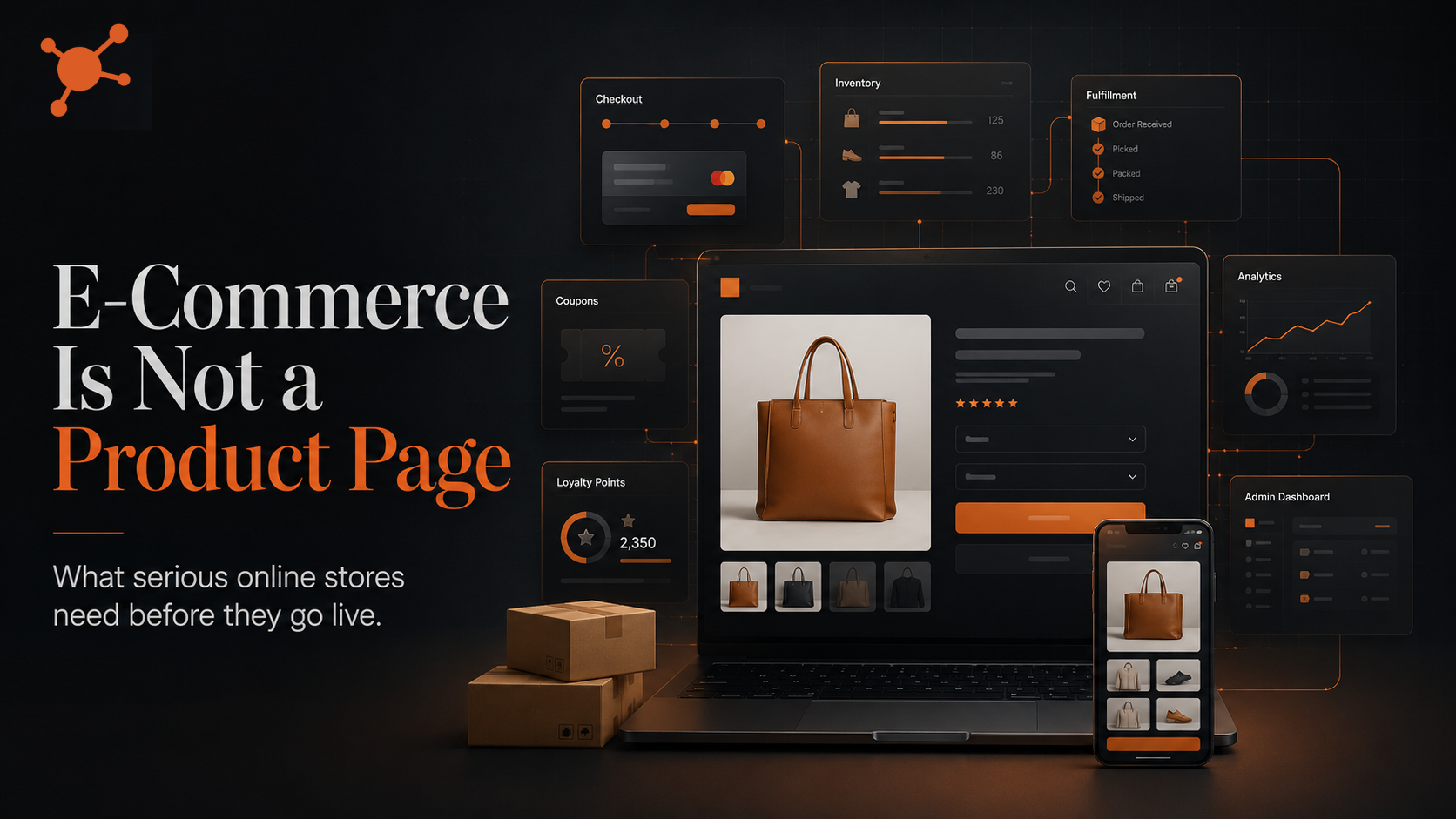
E-Commerce Is Not a Product Page
What serious online stores need before they go live.
Most businesses go online with one goal: show the products and take the money.
So they build a product page. Add a contact button. Maybe a payment link. Call it done.
Then they wonder why customers do not come back. Why orders get missed. Why inventory is always wrong. Why the store feels impossible to manage past fifty SKUs.
The problem is not the product page. The product page was never the hard part.
E-commerce is operations. It is checkout, inventory, fulfillment, coupons, loyalty, returns, and admin — working together, reliably, every single day. The product page is just the front door. Everything behind it determines whether the business actually runs.
This article is for business owners who are building their first serious online store — or rethinking a system that is already breaking under growth.
The first decision: Shopify or custom?
Most businesses frame this wrong — either "Shopify is cheaper" or "custom means we own it." Neither is a useful lens.
The right question is: does your business model fit the defaults, or does it need something different?
When Shopify is the right call
Shopify is a genuinely excellent platform. For the right business, it is the fastest and most reliable path to a working store.
Use Shopify when:
You are selling a defined catalog of physical products with standard variants — size, color, quantity. Your checkout flow is straightforward, with no custom pricing logic, tiered B2B rates, or edge-case tax structures. You want to move fast. Shopify gives you inventory management, discount codes, payment processing, and a mobile storefront in a single setup — a competent team can have a live store running in weeks, not months.
It is also the right choice when the person managing the store is non-technical. Shopify's admin is built for operators. You do not need an engineer to add a product, run a promotion, or read a sales report. And if you are testing a market and are not yet certain about demand, Shopify lets you validate before over-investing in infrastructure.
For most direct-to-consumer brands and businesses entering e-commerce for the first time, Shopify is the correct starting point. Its reliability and speed to market are hard to beat at that stage.
When custom commerce makes sense
Custom does not mean "Shopify but more expensive." It means your business has requirements that platforms cannot satisfy without fighting their own architecture.
Custom commerce is the right investment when:
Your checkout is complex. Loyalty-point redemptions at checkout, split payments, prepaid wallet systems, subscription billing with usage-based adjustments — these are not features you can bolt onto a standard flow without building workarounds that break every time the platform updates.
Your inventory logic is non-standard. Multi-warehouse fulfillment, supplier-linked stock, just-in-time purchasing triggers, or vendor-consignment models require inventory systems that think differently from Shopify's core product model.
Your operational reality is specific. Tax rules, local payment methods, fulfillment workflows, multilingual catalogs, and region-specific operations are not edge cases — they are often the business itself. Custom systems let you build around your reality rather than work around platform limitations.
You need deep integrations. When your e-commerce system has to talk to your ERP, your warehouse software, your loyalty database, and your finance reporting stack, you need an architecture designed for integration — not one that treats third-party connections as plugins.
You are running a marketplace, a subscription business, or a headless setup where the frontend and backend need to be fully decoupled.
The operational layer
Whether you choose Shopify or custom, the following capabilities determine whether your e-commerce operation is functional or fragile.
Inventory
Inventory is the part that kills businesses quietly. Products oversell. Stock levels in the system do not match what is on the shelf. A product shows available during a campaign, the orders come in, and the fulfillment team is manually calling customers to explain why nothing ships.
A working inventory system needs real-time stock visibility, low-stock alerts, and sync across every channel where you are selling — your website, any marketplace, and your physical point of sale if one exists.
Checkout
Your checkout is where customers leave. A complicated, slow, or untrustworthy checkout kills conversion. In markets where customers are predominantly mobile, skeptical of online payment, or accustomed to specific local payment methods, this problem is compounded.
A well-built checkout handles multiple payment options — digital wallets, card payments, bank transfers, cash-on-delivery, and local gateways — shows clear shipping costs before the final step, loads fast on a mobile connection, and builds trust through visible security signals. If your checkout does not do all of this, the product page does not matter.
Coupons and promotions
A discount code that applies to the wrong products. A buy-one-get-one that stacks incorrectly with a sale price. A seasonal campaign that cannot be scoped to specific categories.
The promotions engine needs to handle real campaign logic: percentage discounts, fixed amounts, cart minimums, product-specific rules, user-segment targeting, and expiry windows. When you are running seasonal campaigns, holiday promotions, launch offers, or year-end sales, this flexibility is the difference between a smooth promotion and a customer service crisis.
Loyalty points
Customers who feel rewarded come back. A loyalty system that earns points on purchase, allows redemption at checkout, and shows customers their balance and history creates a reason to return that product pages alone cannot.
The mistake most businesses make is treating loyalty as a marketing feature rather than an operational one. It needs to be integrated into checkout, inventory, and customer accounts — not sitting in a separate app that breaks on promotion day.
Admin operations
The admin experience is where most e-commerce projects quietly fail the people who have to live inside them.
A business owner or operations manager using the admin every day needs to process orders quickly, update product information without engineering help, manage stock levels, issue refunds, run reports, handle customer queries, and set up promotions — without needing a manual or a developer on call.
This means building for operators, not engineers. Clear navigation, bulk actions for common tasks, readable reports that answer real business questions, and role-based access so each team member sees exactly what they need and nothing they should not touch.
When businesses say their e-commerce system needs to be rebuilt, it is almost never the storefront that is the problem. It is the admin.
Mobile-first product pages
Many customers will experience your store only through a phone. If your product pages are designed and tested on a desktop, you are designing for the wrong person.
Mobile-first product pages are not just smaller layouts — they are a completely different interaction design problem. Images that load fast on a cellular connection. Add-to-cart buttons that are easy to tap. Product descriptions that communicate quickly without requiring excessive scroll. Variant selectors that work with a thumb. Social proof visible without digging.
Mobile-first also means performance. A product page that loads quickly converts. A slow page loses a significant share of visitors before they even see the product. This pattern holds across every market, and it is more severe wherever customers are price-sensitive or connection speeds vary.
Headless commerce: when and why
A growing number of serious e-commerce businesses are moving toward headless architectures — where the frontend is completely decoupled from the backend.
The benefit is control. You can build a fully custom shopping experience optimized for your customers and your brand, while using a proven commerce backend for operational logic. You can change the frontend without touching inventory logic. You can run the same backend across a mobile app, a web store, and a kiosk without rebuilding the catalog.
This is not the right architecture for every business — it adds complexity and requires more engineering investment. But for businesses that have outgrown standard templates, or need deeply customized checkout and catalog experiences, headless is the path that makes everything else possible.
Subscriptions and ops integrations
Subscriptions are growing across every category — grocery, wellness, software, content, B2B supplies. A subscription model requires billing logic, failed payment recovery, pause and cancellation flows, subscriber-specific pricing, and a customer portal that does not require a support ticket to manage. This is not a feature addition to a standard store. It is a separate layer of operational logic that needs to be designed from the start.
Operations integrations are what connect your store to your business. Your accounting software needs order data. Your logistics provider needs shipping triggers. Your marketing team needs customer segments based on purchase behavior. Your support team needs order history alongside the customer ticket. These integrations are not optional at scale — they are what turn an online store into a running business.
What BalochDev builds
BalochDev is a software engineering studio building AI-native products, multilingual platforms, and commerce systems on modern web infrastructure.
E-commerce is one of the product areas we build in, and we approach it the same way we approach every serious product: engineering-first, not template-first.
That means helping businesses choose the right foundation. Sometimes that is Shopify. Sometimes it is headless commerce. Sometimes it is a fully custom system because the checkout logic, inventory model, admin workflow, or integration requirements cannot fit inside a standard platform.
Our e-commerce work covers catalog architecture, checkout flows, payment integration, inventory systems, promotions engines, loyalty programs, subscription billing, admin dashboards, and operational integrations.
Because the goal is not simply to launch a store.
The goal is to build a system that can take orders, manage stock, process payments, suport customers, run a compaigns, and keep working as the business grows.
Build the operation, not just the page
If you are planning an e-commerce launch, do not start with the product page.
If you are planning an e-commerce launch, do not start with the product page.
Start with the operational questions:
How will inventory be managed?
How will checkout handle real customer behavior?
What happens when stock runs out mid-campaign?
How are refunds processed?
Who manages orders every day — and does the admin panel actually work for them?
Get those answers right, and the product page becomes straightforward.
Skip them, and you may be rebuilding the system within twelve months.
E-commerce is operations. Build it that way from the start.
BalochDev builds AI-native software, multilingual platforms, and e-commerce systems for businesses that need more than a basic storefront. If you are plannning a launch or rethinking an existing store, lets talk
Want to advertise here? See our ad placements · [email protected]
0 Comments
No comments yet — be the first.