AI · Blog
The AI Model Race Won’t Build Your Product: What Actually Matters for LLM Integration in 2026
GPT-5. Apple Intelligence. Anthropic Mythos. A new frontier model launches every few weeks. Here’s what that race means if you’re the one actually shipping.
It’s June 9, 2026. Tim Cook just unveiled a “completely reimagined” Siri at WWDC. Anthropic is reportedly dropping Mythos tomorrow. The AI model race has never been louder — and if you opened this article, you’ve seen about eleven tweets today telling you this changes everything.
It doesn’t. At least not in the way people think.
If you’re a builder — someone who ships actual products, manages real clients, and deals with production failures at 2am — most of that noise still isn’t the variable that determines whether your product works. This is what is.
The Benchmark Problem Nobody Wants to Admit
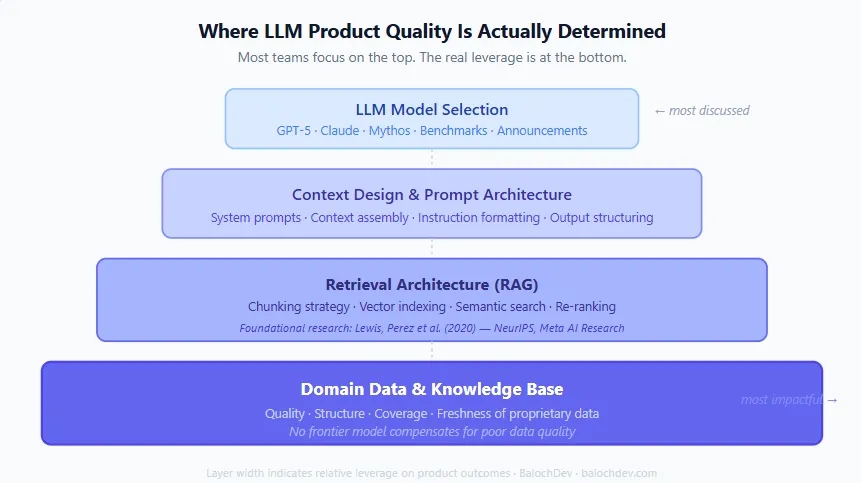
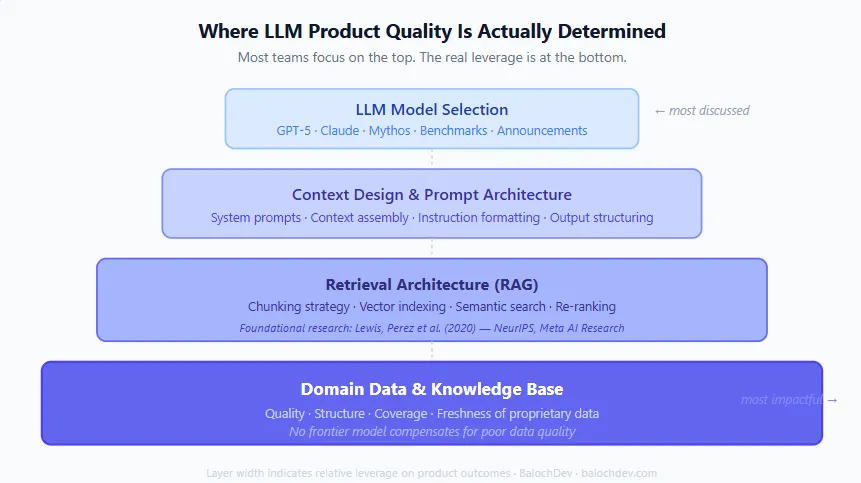
“Diagram showing the layers that actually determine LLM product quality, from model selection (least impactful, most discussed) to domain data (most impactful, least discussed).”
In 2024, Princeton researchers Arvind Narayanan and Sayash Kapoor published AI Snake Oil: What Artificial Intelligence Can Do, What It Can’t, and How to Tell the Difference — a systematic critique of how AI capabilities are measured, reported, and sold.
Their central finding: AI benchmarks are notoriously poor predictors of real-world performance. The evaluations that generate headlines — MMLU, HumanEval, MATH — measure model capabilities in controlled, well-defined settings. Production AI systems operate in messy, domain-specific, context-dependent environments where those measurements frequently fail to translate.
Most product and procurement decisions in 2026 are still driven by benchmark rankings. Teams debate GPT-5 vs. Claude vs. Mythos based on leaderboard positions — when the actual performance gap in their specific domain depends entirely on factors benchmarks don’t touch: the quality of the retrieval layer, the structure of the context assembly, the coverage of the domain data.
Narayanan and Kapoor’s argument isn’t that the benchmarks are fraudulent. It’s that the translation from benchmark score to business outcome is far less reliable than the coverage suggests. That’s the gap nobody in the launch coverage is talking about.
What the Researchers Who Actually Built RAG Found
In 2020, Patrick Lewis and colleagues at Facebook AI Research published “Retrieval-Augmented Generation for Knowledge-Intensive NLP Tasks” — the paper that defined the RAG architecture most production AI systems now rely on.
Their finding was architectural, not about model selection: combining a retrieval mechanism (finding relevant information from an external knowledge store) with a generative model produced results that significantly outperformed pure language models on knowledge-intensive tasks.
“RAG architecture diagram showing the flow from user query through embedding, vector store, context assembly, LLM to response. The retrieval stages are highlighted as where most production quality is determined.”
The practical implication: the quality of what you retrieve, and how you structure it before passing it to the model, is often more determinative of output quality than which model you chose.
Jerry Liu, co-founder of LlamaIndex — one of the most widely used RAG orchestration frameworks in production — has argued consistently across his writing and talks that the bottleneck in most enterprise RAG deployments is the retrieval layer, not the model. Teams spend weeks on model selection, then deploy with naive chunking strategies and poor indexing, and wonder why outputs are inconsistent.
That pattern is the rule in production. Not the exception.
For CEOs and Decision-Makers: Start Here
The cost of waiting for the “right” model is compounding against you right now.
Ethan Mollick, professor at Wharton and author of Co-Intelligence: Living and Working with AI (2024), introduced a concept he calls the “jagged frontier” — the observation that AI capabilities are deeply uneven. These systems are surprisingly powerful at tasks we’d expect to be hard, and surprisingly poor at tasks we’d expect to be easy, in ways that don’t follow intuitive rules.
The practical implication: you cannot know where the jagged
frontier sits in your domain without actually building in your domain. No benchmark, no analyst report, no demo video will tell you. Only production tells you.
Organizations that started building AI integrations in 2023 — even on imperfect models — now have eighteen months of production intuition their competitors don’t have. They know where the jagged frontier sits in their workflows. They’ve structured their data around real failure modes. They’ve built feedback loops.
The strategic ROI question is not “which model is best?” It is “how fast can we build the organizational capability to use any model effectively?”
The risk of imperfect implementation is now lower than the risk of continued inaction. A RAG-powered customer service pipeline running on a six-month-old model and deployed today beats a perfectly architected system built on Mythos that ships in Q4 — every time.
What Actually Changes When a New Model Drops (A Builder’s Honest Assessment)
“Signal vs Noise comparison: what builders should track when a new AI model launches (context window expansion, pricing drops, multilingual improvements, instruction following) vs what to mostly ignore (benchmark rankings, demo videos, keynote claims, launch hype).”
Context window expansion — genuinely significant. Moving from 32K to 200K tokens changes what’s architecturally possible. Fewer retrieval hops, less chunking complexity, new categories of document-heavy workflows become viable. This is a real capability unlock worth tracking.
Pricing drops — the most underreported story in AI. Every 10x reduction in token cost opens an entire category of product that wasn’t economically viable before. This is where AI democratization is actually happening. Not in the benchmark wars.
Multilingual reasoning improvements — critical in our market. Each generation handles code-switching, transliteration, and mixed-script inputs better. For teams building Arabic-English or any bilingual product, these improvements compound meaningfully.
Instruction following improvements — real time savings. Every generation handles ambiguous, multi-step instructions better. This reduces prompt engineering overhead across a codebase. Genuine compounding benefit.
Everything else — primarily marketing. The demo videos, keynote animations, leaderboard movements. These are for investors and press coverage. Not for your architecture decisions.
Building LLM Products for the GCC Market: Why This Matters Even More Here
We build AI integrations for clients in Bahrain, UAE, Qatar, and Saudi Arabia — fintech, logistics, government-adjacent services, workflows that operate in Arabic and English simultaneously, often within the same sentence.
The model race looks different from this vantage point.
None of the major frontier models were optimized for Gulf Arabic dialects, right-to-left document structures, or the compliance language specific to GCC financial regulation. The gap between “ranked highest on MMLU” and “performs well on a bilingual Arabic-English customer service pipeline for a Bahraini fintech company” is significant and unbridged by any benchmark.
What closes that gap isn’t the next frontier release. It’s:
Retrieval architectures designed around Arabic document structure and RTL formatting
Context templates calibrated for code-switching between MSA and Gulf dialect
Domain-specific indexing for GCC regulatory and compliance language
Output formatting designed for the actual downstream workflow the user needs to complete
This is the work. It doesn’t generate keynotes. But it’s what determines whether the product works for real users in this market.
Our experience building Balochi AI — the first AI platform for the Balochi language — makes this viscerally clear. There is no frontier model trained on the Balochi language. No benchmark measures Balochi NLP performance. The entire capability stack has to be constructed from the ground up: data collection, language model adaptation, cultural and linguistic grounding.
That’s an extreme version of the same fundamental problem every GCC business faces with specialized Arabic use cases. The model is a starting point. Not a solution.
A Practical Checklist Before Your Next Model Upgrade
Before you switch models, answer these five questions:
1. Do you have visibility into your retrieval pipeline? Do you know your retrieval recall rate on real user queries? If you can’t answer this, you don’t know where your product is actually failing.
2. Are your LLM calls abstracted from your application logic? If a better model ships tomorrow, can you swap it in an afternoon without rewriting business logic?
3. Are you collecting structured output feedback from real users? This data is the foundation of any future fine-tuning. Most teams aren’t collecting it.
4. Is your domain knowledge indexed for semantic retrieval — or did you use library defaults and move on?
5. Is your chunking strategy designed for your specific document types — technical docs, legal text, product catalogs, chat history — or is it generic?
If any answer is no, that’s higher leverage than any model upgrade. Andrej Karpathy, who helped build foundational systems underlying today’s AI stack, has noted that the interesting work in AI is increasingly in the systems built around models, not the models themselves. The model is becoming infrastructure — critically important, increasingly commoditized.
The Bottom Line
The model race is real. Mythos dropping tomorrow is worth paying attention to. Every generation of frontier model raises the ceiling.
But the ceiling isn’t your constraint right now. Your retrieval quality is. Your context design is. Your domain data is. Your feedback loop is.
The builders who understand that distinction today are building products that will be durable. The ones watching the benchmark race are building on ground that shifts with every announcement.
Ship something on what exists. Upgrade when it matters. Build the systems that make model upgrades easy. That’s the actual strategy.
BalochDev is an AI-first software development studio based in Qatar, specializing in LLM integration, RAG pipeline architecture, and AI agent development for GCC-market clients. We build bilingual Arabic/English AI products and language preservation technology — including Balochi AI, the first AI platform for the Balochi language.
Follow us on X: @BalochDev404
About the Author
Jaber Ali Developer at BalochDev, a Qatar-based AI-first software studio building LLM integrations, RAG pipelines, and bilingual Arabic/English AI products for clients across the GCC. He is also the creator of Balochi AI — the first AI platform for the Balochi language. He writes about what actually happens when you try to ship AI in the real world.
Follow on X: @demiurge_baloch · Studio: @BalochDev404
References
Lewis, P., Perez, E., Piktus, A., Petroni, F., Karpukhin, V., Goyal, N., … & Kiela, D. (2020). Retrieval-Augmented Generation for Knowledge-Intensive NLP Tasks. NeurIPS 2020, Facebook AI Research. arxiv.org/abs/2005.11401
Mollick, E. (2024). Co-Intelligence: Living and Working with AI. Portfolio/Penguin.
Narayanan, A. & Kapoor, S. (2024). AI Snake Oil: What Artificial Intelligence Can Do, What It Can’t, and How to Tell the Difference. Princeton University Press.
Liu, J. (2023–2024). Production RAG writing and documentation. LlamaIndex. llamaindex.ai