Technology · Blog
The Hidden Businesses of the Internet: Why Millions of Local Businesses Remain Invisible Online
The internet has changed the way people discover products, compare services, and decide where to spend their money. Today, finding a restaurant, mechanic, clothing store, medical clinic, or nearby service provider can take only a few seconds.
But there is another side to this digital revolution.
While major brands dominate search results, countless local businesses remain difficult to find online. Some have no website. Others depend entirely on social media pages, outdated directory listings, or word-of-mouth recommendations. Many operate successfully in their communities but have almost no visibility beyond their immediate surroundings.
This creates an important question: If a business exists but customers cannot find it online, how much opportunity is it losing?
Local business discovery is becoming an important part of the digital economy. Helping customers find the right businesses requires more than putting business names on a map. It requires better search infrastructure, accurate information, accessible platforms, and technology designed around how people actually search.
1. The Digital Visibility Gap
Not every business has the resources, technical knowledge, or time to establish a strong online presence.
Large companies often have dedicated marketing teams, professionally developed websites, advertising budgets, and search engine optimization strategies. Small businesses, on the other hand, may operate with limited resources.
A local shop might have loyal customers, competitive prices, and excellent service, yet remain almost invisible to someone searching online.
This creates a digital visibility gap between businesses that have successfully established their online presence and those that have not.
The problem is not necessarily the quality of the business. It is often the lack of accessible digital infrastructure that helps customers discover it.
For small businesses, digital visibility is no longer simply an additional marketing advantage. It is increasingly becoming an important part of competing in a connected marketplace.
2. Why Traditional Business Directories Are No Longer Enough
For years, business directories helped people find shops, restaurants, service providers, and professional organizations.
However, modern customers expect much more than a list of names and telephone numbers.
They want to know:
Where is the business located?
What products or services does it offer?
Is the information accurate and up to date?
How can they contact the business?
Can they compare nearby alternatives?
Can they find the business easily on their mobile devices?
Traditional directories do not always provide the speed, usability, search functionality, or structured information that modern users expect.
Some platforms also suffer from excessive advertisements, outdated listings, complicated interfaces, or incomplete business information.
The next generation of local discovery platforms needs to move beyond static directories and become intelligent, searchable digital environments.
3. The Technology Behind Local Business Discovery
Making local businesses discoverable involves several technologies working together.
Search-first architecture
A discovery platform should be designed around the user's search experience.
Instead of forcing visitors to navigate complicated categories, it should make it easy to search for businesses, explore available options, and access relevant information.
A well-designed search experience reduces friction between a customer's need and the business that can fulfill it.
Search engine optimization and structured data
Search engines need to understand the content of a website.
Structured business information can help search engines interpret details such as business names, locations, categories, and services.
Technologies such as Schema.org structured data can make business information more understandable to search engines when implemented correctly.
Clean, descriptive, indexable URLs and well-organized business pages also help create a stronger technical foundation for organic discovery.
Location-based discovery
Location is central to finding local businesses.
Customers often search for services based on their current location or a particular area. Interactive maps, location information, and map clustering can make it easier to explore businesses across different neighborhoods.
Combining searchable business information with geographic discovery creates a more useful experience than relying on a simple directory list.
Mobile-first experiences
Many customers discover local businesses using smartphones.
A platform should therefore load quickly, display information clearly, and provide a simple experience across different screen sizes.
If users struggle to navigate a business listing on their phones, they may leave before finding what they need.
Trust and information management
A business discovery platform is only as useful as the information it provides.
Outdated addresses, incorrect contact details, duplicate listings, and misleading information can damage user confidence.
Business verification, moderation workflows, and effective listing management are important parts of maintaining a reliable discovery ecosystem.
4. The Challenge Is Not Just Finding Businesses — It Is Making Them Discoverable
There is a difference between storing business information and building a system that makes that information useful.
A basic directory may contain thousands of listings, but if those listings are difficult to search, poorly organized, or invisible to search engines, their practical value remains limited.
A modern discovery platform must connect three important elements:
Businesses: They need a straightforward way to establish and manage their digital presence.
Customers: They need accurate information and an easy way to find relevant services.
Search infrastructure: It must organize, index, and present business information efficiently.
When these elements work together, local businesses have a better opportunity to reach people beyond their existing customer networks.
This is where software engineering becomes important. The quality of the underlying architecture directly influences how effectively a discovery platform can serve businesses and customers.
5. Building Local Discovery Infrastructure: The FindUs Case Study
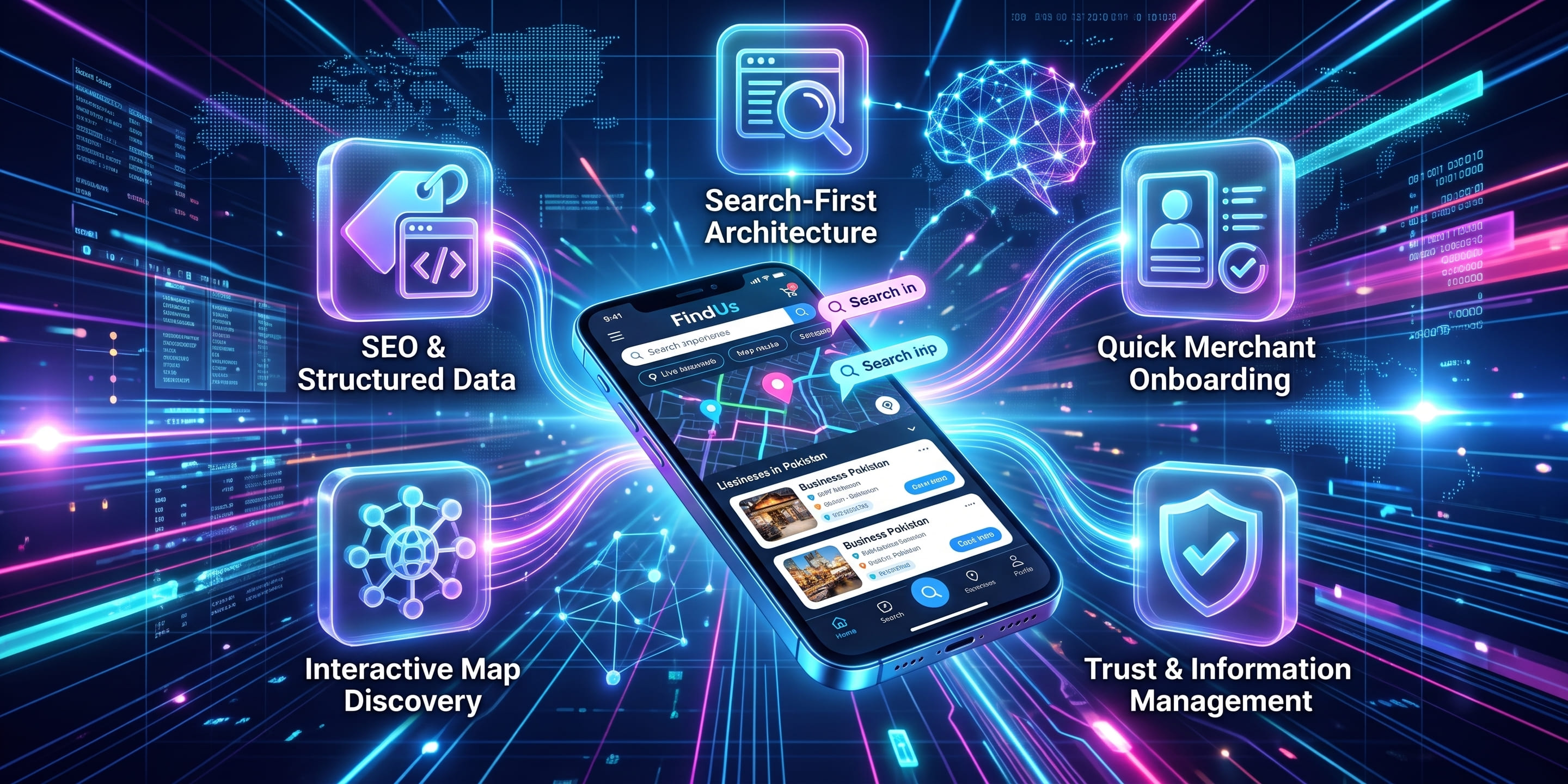
At BalochDev, we explored this challenge through FindUs, a local business discovery and search platform built for Pakistan.
The project began with a recognizable problem: many local businesses lacked structured digital visibility, while existing discovery experiences could be slow, cluttered, or difficult to navigate.
Rather than building another basic business directory, the goal was to develop a search-first platform that makes local business information easier to discover.
The engineering approach focused on several areas:
Search-first platform architecture
We developed server-rendered business pages to establish a foundation for accessible, search-friendly business discovery.
Structured business information
Schema.org structured metadata was incorporated to help organize business information for search engines.
Interactive map discovery
Map clustering was implemented to help users explore businesses geographically.
Simplified merchant onboarding
The platform was designed around a three-minute merchant onboarding flow, reducing the effort required for businesses to establish their listings.
Performance and listing management
The system focused on high-speed pages, clean indexable URLs, automated moderation workflows, and zero-code listing operations.
The result is FindUs, a local discovery platform designed to improve how businesses become visible and how customers find them.
FindUs represents one example of how thoughtful engineering can address a practical problem in the digital economy.
6. Why Local Business Discovery Matters Globally
The challenge of local business visibility is not limited to one country or region.
Across different markets, small businesses compete for attention in increasingly digital environments.
A family-owned restaurant, independent repair shop, neighborhood clinic, local clothing store, or small professional service provider can all benefit from better online discoverability.
Improving local discovery can create value for different groups:
Customers can find relevant businesses more easily.
Small business owners can establish a stronger digital presence.
Local communities can gain better access to nearby services.
Entrepreneurs can reach potential customers beyond traditional networks.
Digital platforms can create more useful connections between businesses and consumers.
The opportunity is not simply to put every business online. It is to build digital systems that make business information accessible, understandable, and useful.
7. What the Future of Local Search Could Look Like
Local search is evolving alongside artificial intelligence, location-based technologies, and more advanced search experiences.
In the future, customers may rely increasingly on conversational search to describe exactly what they need.
For example, instead of searching for a generic category, someone might ask:
"Find a reliable electronics repair shop near me that is open today."
To answer such requests effectively, discovery systems need accurate business information, structured data, relevant categories, and dependable location information.
Artificial intelligence may improve how users interact with these systems, but its usefulness will depend on the quality of the underlying data.
Better search interfaces alone cannot solve the problem if business information is incomplete or outdated.
The foundation of future local discovery will therefore remain a combination of reliable data, thoughtful engineering, accessibility, and useful search experiences.
Conclusion: Every Business Deserves to Be Discoverable
The internet has created extraordinary opportunities for businesses, but those opportunities are not equally accessible.
Some companies have established strong digital identities, while others remain hidden behind outdated listings, limited online information, and disconnected platforms.
Closing this visibility gap requires more than marketing campaigns. It requires practical technology that helps businesses establish their presence and enables customers to discover them.
At BalochDev, we believe software should solve real problems. Projects like FindUs demonstrate how engineering, search technology, and thoughtful product design can help make local business discovery more accessible.
Because the next great business a customer discovers should not necessarily be the biggest brand. It could be the small business just around the corner.
Explore FindUs: https://findus.com.pk/
Discover more about BalochDev: https://balochdev.com/