Blog
Is AI Now Called "SI"? What the Executive Order Actually Says
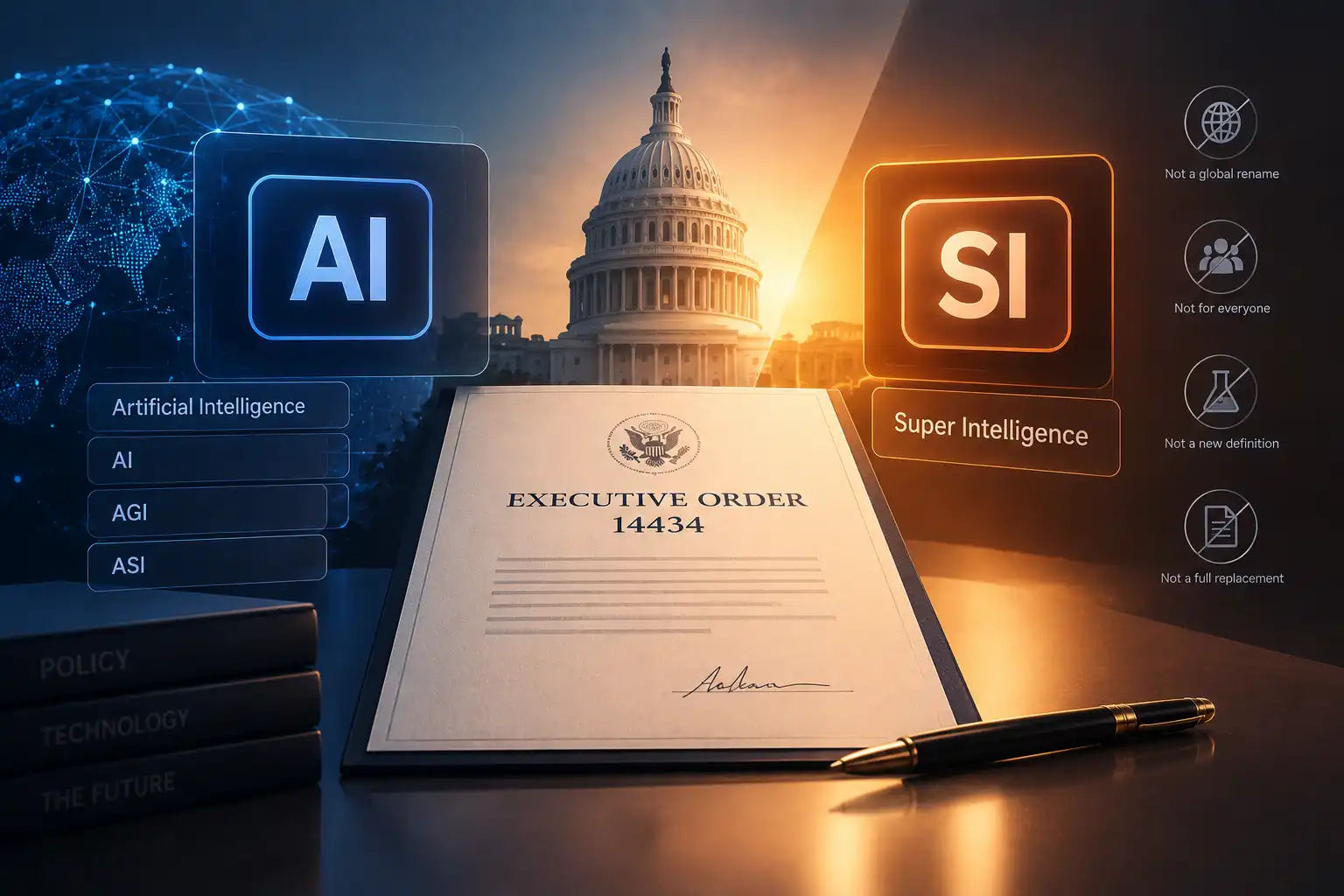
No — AI has not been globally renamed SI.
What actually happened: on September 29, 2026, the U.S. executive branch adopted "Super Intelligence" and "SI" as its own preferred terminology for artificial intelligence, via Executive Order 14434. That is a real, binding instruction to federal agencies — but it is not a global rename, a scientific reclassification, or a rule that applies to private companies, other governments, or the research community. Below is exactly what the order requires, what it leaves untouched, and the specific date in late November 2026 worth watching for a possible second phase of this story.
What happened on September 22?
At the United Nations General Assembly, President Trump told the audience the U.S. government would begin referring to artificial intelligence as "Super Intelligence" going forward. The statement came after several days of social-media discussion — Netcraft's own research traced speculative domain-registration activity back to around a September 19 Trump poll about renaming AI, meaning some market reaction preceded the speech itself. The UN remarks attracted immediate attention because a sitting head of state proposing to change the government's own vocabulary for a major technology is unusual, and because — as covered in our companion piece — the announcement set off a measurable surge in registrations of Slovenia's .si domain, whose two-letter country code happens to match the new term's abbreviation.
What happened on September 29?
Trump signed Executive Order 14434, titled "Inaugurating the Era of Super Intelligence." It was published in the Federal Register on October 2, 2026, as document 2026-20321, at 91 FR 63129.
What it says, section by section:
Section 1 (Purpose). States that today's AI systems "do much more than imitate or automate discrete aspects of human intelligence" and sets administration policy that, to the maximum extent permitted by law, the executive branch will use "Super Intelligence" and "SI" instead of "Artificial Intelligence" and "AI."
Section 2 (Implementation). Directs agencies to use the new terms in official correspondence, public communications, websites, reports, policy documents, and other non-statutory material — but explicitly does not require altering previously issued regulations, prior presidential actions, contracts, grants, or historical documents.
Section 3 (Definition). Defines "Super Intelligence" and "SI" as meaning exactly the technologies already covered by "artificial intelligence" under 15 U.S.C. § 9401(3) — and sets a 60-day deadline for a legislative proposal on a formal statutory definition (see Section 8 below).
Section 4 (General Provisions). Standard boilerplate: doesn't expand any agency's authority, doesn't create an enforceable right for any outside party, and is subject to available funding.
What does the executive order actually define?
This is the section worth reading carefully, because most casual coverage of this story skips it.
Section 3(a) of the order doesn't invent a new definition of "Super Intelligence." It borrows one, by direct legal reference: SI is defined as meaning the same technologies and systems already covered by "artificial intelligence" in 15 U.S.C. § 9401(3), the definition written into the National Artificial Intelligence Initiative Act of 2020. That statute defines AI as a machine-based system that, given human-defined objectives, can make predictions, recommendations, or decisions affecting real or virtual environments — a broad, long-standing legal definition, unchanged by this order.
The practical consequence: SI is a relabeling of the existing legal category of AI, not a claim that today's systems have crossed into some new, more advanced capability tier. The order is explicit that this definition governs "unless and until superseded by subsequent Presidential action... or by an Act of Congress" — meaning, as of today, nothing has actually redefined what counts as AI/SI under U.S. law. Only the name changed.
AI vs. SI vs. AGI vs. ASI
Four terms that get conflated constantly in coverage of this story, and shouldn't be:
AI (artificial intelligence) is the statutory definition in 15 U.S.C. § 9401(3): a machine-based system making predictions, recommendations, or decisions from human-defined objectives. This definition is unchanged — it's the definition SI points back to.
SI (the new federal term) is a relabeling of that same AI definition for executive-branch use, as of September 29, 2026. It's new terminology only, not a new technology or threshold.
AGI (artificial general intelligence) is a research concept: human-level ability across most intellectual tasks, with no official U.S. statutory definition. It's unaffected by the order and unrelated to it.
ASI / "artificial superintelligence" is a research concept used in AI-safety literature for years, predating this order: a hypothetical system exceeding the best human performance across essentially all domains. It's unaffected by the order and unrelated to it.
Does "SI" mean superintelligence in the technical sense?
Here's the distinction worth being precise about, because it's the single most common conflation in coverage of this story: the government's capitalized "Super Intelligence" (SI) is a name the executive branch chose for the existing, broad legal category of AI. The AI-safety research community's lowercase "superintelligence" / ASI is a hypothetical capability level — systems that would exceed top human performance across essentially every domain, a concept researchers have discussed for years, independent of any government terminology decision.
These are not the same claim, and the order does not assert the second one. Nothing in Executive Order 14434 states or implies that current systems have reached artificial superintelligence in the research sense — it's a branding decision applied to the systems that already existed under the old name. We found no evidence of pre-existing, widespread use of "SI" as a term of art in AI research circles to mean what the order now uses it for; the research literature's standard vocabulary remains AI, AGI, and ASI.
Does the executive order apply to everyone?
No. Its scope is narrow and explicit:
U.S. federal executive agencies: Yes — this is who the order binds, under Section 2(a).
Congress: No. The order is an executive action; it doesn't bind the legislative branch, and existing statutes still say "artificial intelligence."
Courts: No.
U.S. states: No.
Private companies: No. Section 2(a)'s language covers "executive departments and agencies" specifically — it says nothing about company terminology, products, or marketing.
Foreign governments: No.
The scientific/research community: No — nothing compels researchers to adopt the term, and as noted above, there's no sign they have.
What happens next?
Section 3(b) of the order gives the Assistant to the President for Science and Technology 60 days from the signing date — working out to roughly November 28, 2026 — to submit proposed legislative language to the President. That proposal has to include an assessment of whether a formal "Super Intelligence" definition should modify, expand, or replace the existing statutory AI definition, along with any conforming changes to statutes that currently say "artificial intelligence."
This is worth watching closely for two reasons. First, it's a concrete, dated future event — not a vague "stay tuned." Second, it's where an actual legal redefinition could begin; today's order borrows the existing definition verbatim, so nothing legally binding about AI's definition has changed yet. A proposal landing around late November would still need further presidential or congressional action to take effect, but it would be the first real sign of whether this is purely a terminology exercise or the opening move toward something with legal teeth.
Why did people connect SI with .si domains?
Briefly, since our companion piece covers this in depth: .si is Slovenia's country-code domain, unrelated to this executive order in any official sense. Once "SI" became the federal government's new shorthand for AI, domain investors noticed the letters matched Slovenia's ccTLD and began registering .si names — the same pattern that made Anguilla's .ai valuable once "AI" became commercially hot. Registration volume for .si rose sharply around both the September 22 speech and the September 29 order. For the full registration data, the speculation-versus-adoption breakdown, and a .si-vs-.ai cost comparison, see "The .SI Domain Boom, Explained."
Is "SI" replacing "AI"?
The honest answer depends entirely on which context you mean:
U.S. executive-branch terminology: Yes — the order directs it, and at least one agency has already acted on it concretely: NIST has published a dedicated "Super Intelligence" section at nist.gov/super-intelligence, stating it "is working to update its communications to incorporate the term 'super intelligence' as directed," and has renamed its AI standards work there accordingly (its Information Technology Laboratory now runs what it calls an "ITL SI Program"). That's a more concrete step than a policy preference on paper — it's a federal agency's own public-facing terminology actually changing.
The global technology industry: No evidence of this. Nothing in the order requires it, and we found no indication major AI companies have changed their own terminology.
Scientific research: No evidence of this either — AI, AGI, and ASI remain the standard vocabulary in the literature.
Private companies generally: Not required. The order has no authority over private-sector communications.
The domain market: The term has generated real, measurable speculation around
.si— but.siitself remains, legally, nothing more than Slovenia's ccTLD.
What should readers watch next?
Whether the November 28-ish legislative proposal actually arrives, and what it says about a formal statutory definition
How broadly federal agencies actually implement the terminology shift in practice — NIST is the clearest example so far, with a live nist.gov/super-intelligence section already in place; whether other agencies follow with their own dedicated pages, or this stays mostly confined to NIST, is still unfolding
Whether any private company voluntarily adopts "Super Intelligence" branding
Whether the research community engages with "SI" at all, or continues using AI/AGI/ASI as before
Whether the
.siregistration boom continues once the initial news cycle fades, or reverts toward its historical baselineWhether genuine end-user
.siadoption — actual operating businesses, not resale listings — starts to show up in the data
Conclusion
AI has not been globally renamed "Super Intelligence." What happened in late September 2026 is narrower and, in its own way, more interesting: the U.S. executive branch adopted a new label for an existing, legally unchanged category of technology, while the rest of the technology and research world — so far — keeps using AI, AGI, and ASI exactly as before. The more consequential question isn't whether AI has been renamed. It's whether the 60-day legislative review due around late November turns this from a vocabulary preference into something with actual statutory weight — and whether, outside government paperwork, "Super Intelligence" ever becomes a term anyone other than federal agencies and domain speculators actually uses.
References
Federal Register, Executive Order 14434, Inaugurating the Era of Super Intelligence, 91 FR 63129 (Oct. 2, 2026)
The White House, Executive Order 14434 (signed Sept. 29, 2026)
15 U.S.C. § 9401(3), National Artificial Intelligence Initiative Act of 2020 (Cornell Legal Information Institute)
Wiley LLP, "Executive Order Rebrands AI as 'Super Intelligence' and Signals Potential Federal Legislative Changes"
NIST, "Super Intelligence" program page (nist.gov/super-intelligence)
Netcraft, Sept. 24 and Oct. 1, 2026 posts on the
.siregistration surge
See our companion piece, "The .SI Domain Boom, Explained," for the full registration-data and domain-market analysis.